
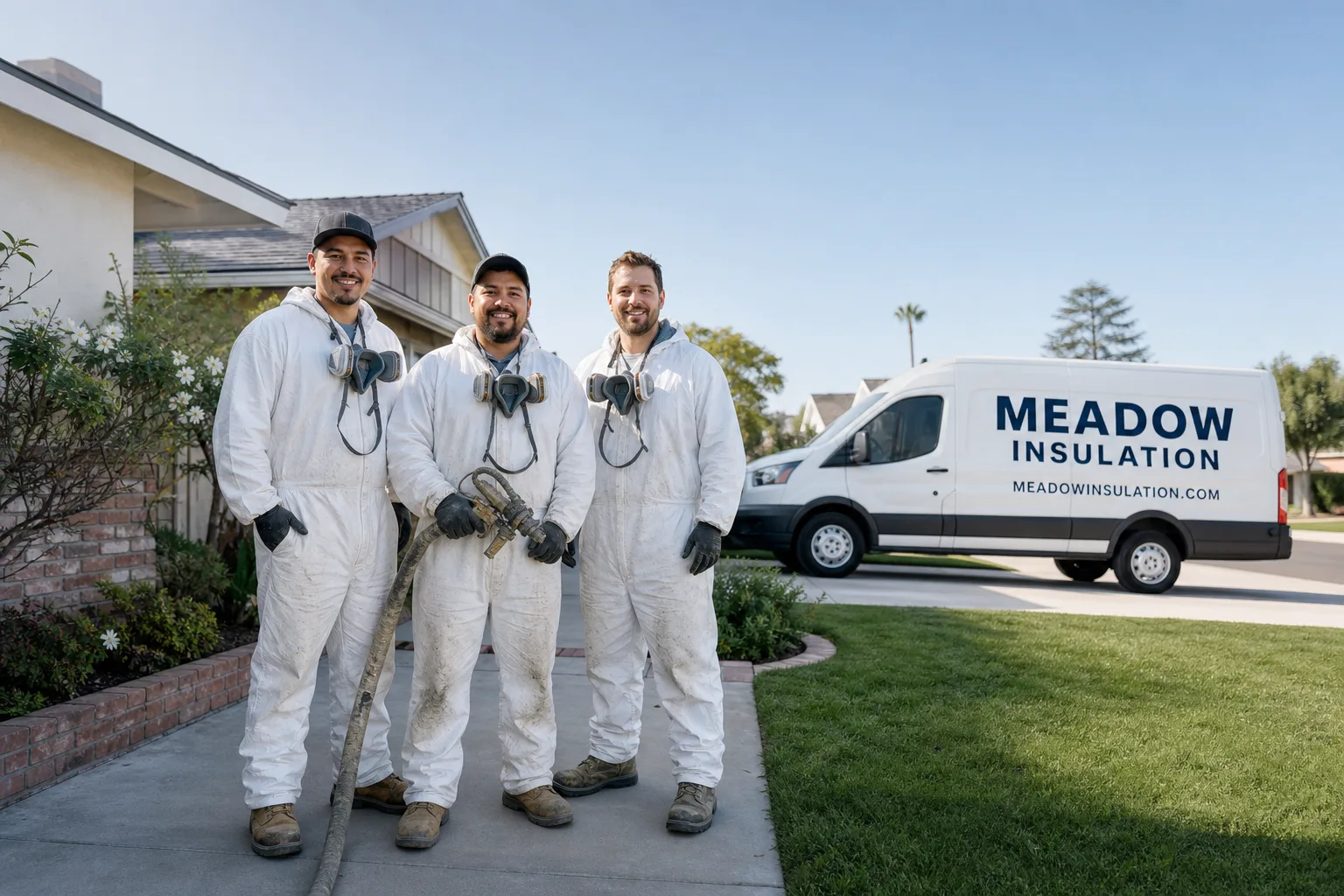
Fast, Reliable Attic Insulation Across Covina
If your Covina home has original insulation from the 1950s or 1960s, you’re likely losing cooling every summer afternoon while the attic climbs past 130°F. Our Attic Insulation crews work across Covina weekly, from the tree-lined blocks near Covina Park to the tract homes off Badillo Street, and we typically reach 91722, 91723, and 91724 within 24 to 48 hours of your call. We know these houses because they’re what we work in most: low-pitch roofs, single-story stucco, and attics that have collected decades of San Gabriel Valley air. Call (833) 589-8312 for a free estimate, and we’ll start with a straight answer about what’s actually happening up there.
Why Meadow Insulation Is Covina’s Preferred Attic Insulation Company
Homeowners in Covina tend to ask the same first question: why is my back bedroom always ten degrees warmer than the living room? The answer usually sits in the attic, not the HVAC. Meadow Insulation approaches every Covina job as an inspection first. We don’t show up with a single product and try to make it fit. We measure what’s already there, check the ventilation, look at how the sun hits your roof, and then recommend a material from eight manufacturers: Owens Corning, Johns Manville, Knauf, Rockwool, CertainTeed, Icynene, Demilec, and GreenFiber. That product-neutral approach matters in a city with as much housing variety as Covina.
Allen Drummond, who leads our team, has walked more Covina attics than most contractors have in the whole Valley. What that means for you: we recognize the failure patterns in these older tracts before we even climb the ladder. We know the difference between a 1970s Ranch with some life left in its batts and a 1955 model where the insulation has turned to a compressed gray mat. Covina customers call us because they want an honest read on whether a top-up will do the job or a full removal and replacement makes more sense.
Attic Ventilation in Covina
Attic Ventilation in Covina is not a one-size-fits-all calculation, and anyone who tells you otherwise hasn’t crawled around enough attics in 91723. The job involves assessing intake and exhaust airflow: soffit vents, gable vents, ridge vents, or a combination, depending on the roof profile and what the original builders installed, if anything. In Covina’s low-pitch tract homes, inadequate ventilation traps heat that radiates down through the ceiling all evening long.
Expect a ventilation assessment and correction to run $350 to $900 on most Covina homes, depending on the vent count, roof shape, and whether we need to clear blocked soffits first. Some older homes need baffle installation to keep fresh air moving past the insulation, which runs $200 to $500 additional. If attic temperatures have been spiking, we check ventilation before any insulation upgrade, because new insulation over a suffocated attic just creates a hotter, damper mess.
When a Covina Attic Needs Help
Soffit vents clogged with decades of dust and old paint, gable vents that were never adequate for the roof area, or ridge venting that doesn’t exist: these are the recurring themes. We map the existing vents, calculate the needed net free vent area for the home’s square footage, and quote only what the attic actually requires. That’s the difference between fixing the problem and adding vents for the sake of adding vents.
Urban Conditions and Airflow
Covina’s built environment shapes ventilation needs block by block. On an open, sun-exposed lot, ridge venting can make a dramatic difference. On a tight single-story lot shaded by mature oaks, the priority shifts to keeping moist air moving so it doesn’t condense inside the attic cavity. Two homes on the same street can have meaningfully different ventilation prescriptions. We evaluate what’s in front of us, not a template.
Radiant Barrier in Covina
Radiant Barrier for Covina homes addresses the single biggest attic problem in the eastern San Gabriel Valley: radiant heat gain from the roof deck. In the 1950s and 1960s tract homes across 91722 and 91724, Reflectix repair in Covina is often needed for reflective foil installed in the 1970s and 1980s that has peeled, torn, or lost its low-emissivity surface. We can assess whether your barrier is still doing anything, and what a replacement or first-time installation would actually save you on cooling load.
For a typical Covina ranch, installing a new radiant barrier across the roof rafters or over the existing attic floor insulation runs $0.80 to $1.40 per square foot, with most homes landing between $1,200 and $2,800 all-in. It’s not a substitute for insulation; it’s a layer that changes how much heat enters the attic in the first place. In Covina’s climate, where summer afternoons sit in the 90s and low 100s for weeks, that’s often the difference between a livable second bedroom and one that runs a window unit around the clock.
Radiant Heat and Attic Temperatures
Roof decking facing the sun can reach 160°F here in July, and that heat radiates straight into the attic air. A functioning radiant barrier reflects most of it before it can ever warm the insulation or the ducts below. In Covina, where many homes still have HVAC ducts running through unconditioned attics, this one improvement changes both comfort and monthly energy draw.
Older Barrier Failures
We regularly puncture-test old radiant barrier and find it has delaminated from the rafters or accumulated so much Santa Ana grit that it no longer reflects. Homeowners often don’t realize a barrier is even there, because it predates their ownership. A quick attic inspection tells us whether repair is possible or whether a clean new installation makes more sense.
Trusted Brands We Service in Covina
Meadow Insulation is authorized to install Attic Insulation in Covina across every major material category. We work with Owens Corning fiberglass, Rockwool mineral wool, Johns Manville batts, Knauf applications, plus Icynene and Demilec spray foam, CertainTeed, and GreenFiber cellulose. Because we carry this many product lines, we don’t have to sell you a solution that’s comfortable for us. We match the material to the home: mineral wool for fire-resistance near flues, cellulose for recycled-content on tighter budgets, open-cell foam for air-sealing in old framing. For Covina homeowners, that means one crew, one warranty relationship, and the right product the first time. Turnaround on most attic treatments is one day, and we keep common materials staged for quick delivery to Covina.
Common Attic Insulation Problems We See in Covina Homes
- Compressed, dust-filled original batts. Decades of Santa Ana episodes layer fine grit into fiberglass, and foot traffic from plumbers, electricians, and HVAC crews flattens the material even further. We routinely find R-19 batts performing closer to R-9 in Covina attics.
- Failed radiant barrier in 1950s and 1960s tract homes. The foil originally stapled under rafters cracks, tears, and collects a film of grime that kills its reflective capacity. Homeowners rarely know it’s there, and even more rarely know it’s doing nothing.
- Poor ventilation in tree-covered heritage blocks. Older neighborhoods with mature citrus and oak canopy trap humidity in the attic, degrading insulation and encouraging mold growth on the underside of the roof deck. Ventilation fixes are often the missing piece before new insulation goes in.
- Converted detached garages with zero attic treatment. Covina has a long tradition of turning detached garages into ADUs or bonus rooms, and most were framed and finished without any thought to insulation or air sealing. We retrofit these spaces regularly, bringing them up to something that actually holds temperature.
Pricing for Attic Insulation in Covina, CA
Here’s what Covina homeowners can expect on a typical attic insulation job in 2026. A blown-in GreenFiber or Owens Corning fiberglass top-up over existing insulation runs $1.20 to $1.80 per square foot for a 1,100 to 1,600 square foot attic: think $1,300 to $2,900. Full removal of old contaminated batts plus air sealing and new blown-in insulation to R-38 runs $4,200 to $7,500 on most tract homes. Batt replacement with Rockwool or Johns Manville runs $2.50 to $3.50 per square foot. Spray foam in a hard-to-vent attic runs $3.50 to $6.00 per square foot. Every quote includes a free inspection. Call (833) 589-8312 and we’ll put firm numbers on your specific roofline.
We Also Serve Cities Near Covina
Our crews run jobs in Covina daily, and we also cover Irwindale, Citrus, West Covina, and Glendora. If you’re just over the Covina line in any direction, call us; we schedule these routes together to keep response times short. Same crews, same eight-brand product range, same no-pressure inspection process.
Serving Covina, CA — Our Local Coverage Area
We’re based in the Covina area and know this community well. Use the map below to see our service coverage — if you’re nearby, we can almost certainly help.
FAQs About Attic Insulation in Covina
Dust and smog settle into attic insulation, coating the fibers and filling the air pockets that give insulation its R-value. In Covina homes near the 10 and 210 corridor, we’ve measured original R-19 batts performing below R-10 because of a visible gray mat of grit through the attic. That’s why removal and replacement is so often the right move here rather than simply topping up. Call (833) 589-8312 and we’ll inspect what’s actually happened to yours.
Insulation slows conductive heat transfer, but it doesn’t stop radiant heat from the roof deck beating down into the attic space. A radiant barrier reflects that heat before it reaches the insulation, which keeps both the attic and the ducts cooler. In Covina’s hot, sunny climate, the two layers work together; insulation without a barrier still lets the attic become an oven that taxes your air conditioner. We can measure the difference during a free inspection.
Homes on older citrus-heritage blocks with dense canopy have different ventilation needs than homes on exposed infill lots. Trees shade the roof, which lowers attic temperatures, but they also block airflow and add moisture. Ventilation in these homes needs to prioritize movement and drying, not just heat reduction. On a fully sun-exposed tract home, the opposite is true. That’s why we assess per block, not by city template.
Plan on removal and replacement. R-11 was never adequate for the Inland Empire’s cooling load, and after six or seven decades it’s compressed, dirty, and often inhabited by rodents. We remove the old material, air-seal ceiling penetrations like can lights and attic hatches, and install new blown-in insulation to R-38 with a radiant barrier option. The improvement is immediate, and many Covina customers notice lower cooling bills in the first month.
Yes, and we do it regularly. Covina’s older neighborhoods have hundreds of detached garages converted into workshops, studios, and rental units, most with no insulation or just a few batts thrown in the rafters. We treat these spaces like attics: air-seal first, ventilate properly, then insulate with blown-in fiberglass or spray foam depending on the roof structure. It’s one of the highest-impact improvements you can make to these small spaces.
Written by Allen Drummond, Owner at Meadow Insulation, serving Covina and the San Gabriel Valley.