Fast, Reliable Attic Insulation Across Pico Rivera
Attic insulation in Pico Rivera typically costs between $1,200 and $3,800 for a full retrofit on the dominant 1950s-60s tract homes that fill the 90660, 90661, and 90662 zip codes, with most jobs completed in a single day. The work that pays for itself fastest here isn’t heating-season insulation, it’s reversing what decades of inland heat have done to original attic material. If your electric bill spikes every July and your upstairs rooms never quite cool down, the attic is almost certainly where the problem starts. Call (833) 589-8312 for a free estimate from a crew that knows Pico Rivera’s housing stock down to the roof pitch.
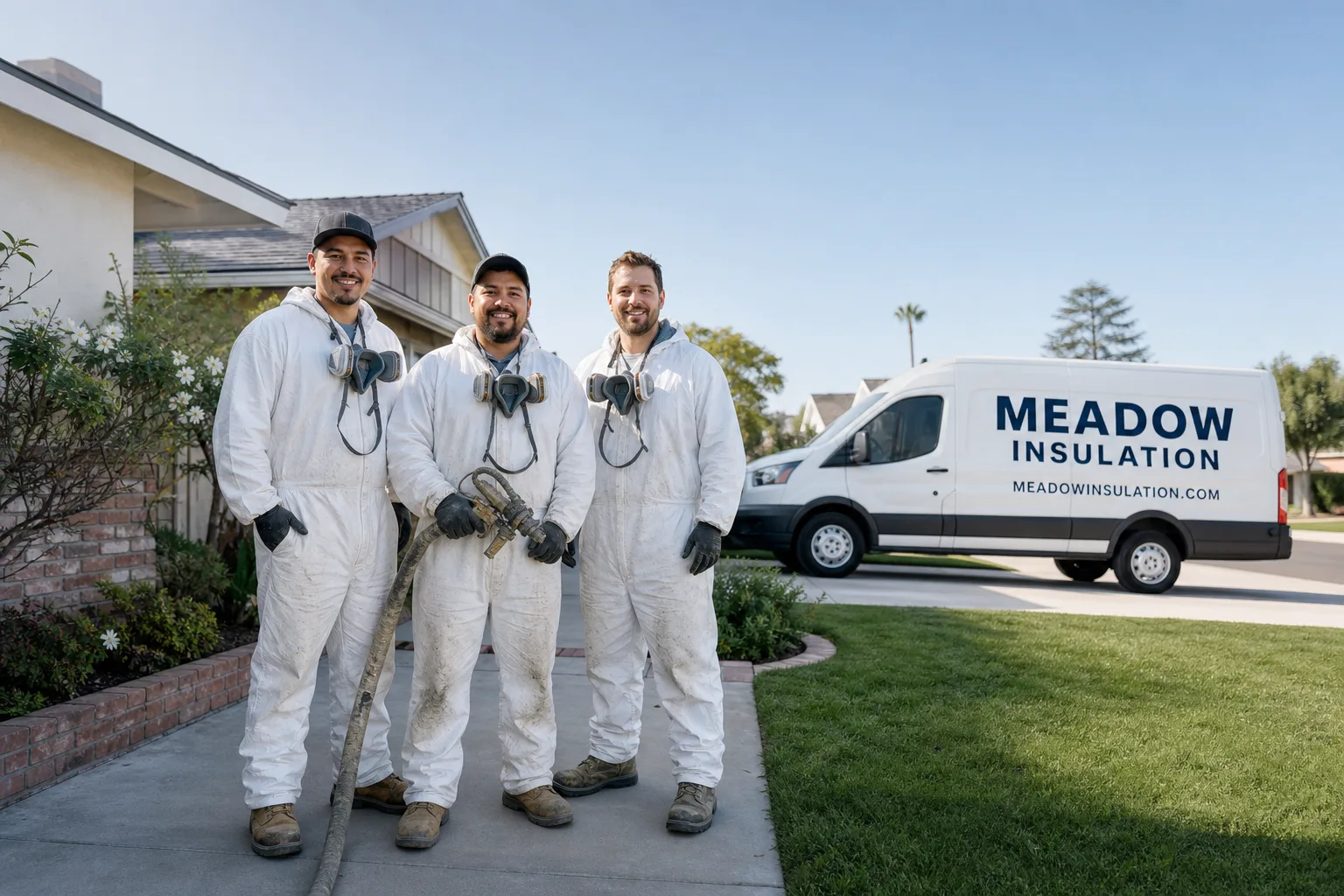
We’re Meadow Insulation, and we’ve spent enough time crawling through Pico Rivera attics to know exactly what’s up there before we even open the hatch. This isn’t a city of new construction. It’s a city where the insulation decision was made in 1957, and the bill has been compounding ever since.
Why Meadow Insulation Is Pico Rivera’s Preferred Attic Insulation Company
Pico Rivera homeowners call us because we understand what’s actually inside their attics, not because we’re the cheapest. The homes here, most of them compact single-story stucco tracts built between the early 1950s and late 1960s, have shallow-pitch roofs and attics that most insulation crews find genuinely difficult to work in. We’re familiar with the tight clearances, the pinched eaves, and the original Kraft-faced batts that have been up there for six decades doing almost nothing.
Our work in Pico Rivera has taken us into homes across the Smith Park area, the neighborhoods off Rosemead Boulevard, and the older streets near the Whittier Boulevard corridor where the housing stock predates the tract boom. Homeowners consistently mention two things: we showed up when we said we would, and we explained what we found in plain English before touching anything. That second part matters. A lot of Pico Rivera attics have been insulated more than once, and the homeowner never knew what was actually done. We tell you what’s there, what failed, and what we recommend, then we do the work or we don’t. No pressure.
Led by Allen Drummond, our team treats every Pico Rivera attic as a retrofit project with a specific set of problems, not a blank canvas. That’s the difference between insulation that looks fine on paper and insulation that actually changes your summer electric bill.
Attic Insulation Removal in Pico Rivera
Attic Insulation Removal in Pico Rivera almost always means pulling out original 1950s-60s Kraft-faced batts that have compressed, been soiled by rodents, or disappeared entirely in sections while the homeowner assumed the attic was still insulated. The removal work itself involves extracting the degraded material, cleaning the attic deck, and prepping the surface for air-sealing before any new insulation goes in. A typical removal on a Pico Rivera tract home runs $600 to $1,200 depending on attic size and accessibility.
When Removal Is Non-Negotiable
If the original batts are still up there, they’re usually doing nothing. Compressed fiberglass batts lose most of their R-value, and rodent-soiled material is a health issue before it’s an efficiency issue. In Pico Rivera’s shallow attics, we frequently find that the batts near the eaves are simply gone, shifted during decades of Santa Ana-driven air movement or pushed aside during old roof work. Leaving failed material in place and blowing new insulation over it is a waste of money. The removal has to happen first.
What Removal Costs and Includes
The removal itself is straightforward but physically demanding work in a tight space. Our crew bags the old material, extracts it through the attic access, and cleans the deck enough to inspect the top plates and ceiling penetrations. That inspection matters: in Pico Rivera tract homes, the top plates were rarely sealed when the house was built, and you can’t seal them through six inches of old, degraded batt.
Insulation Contractors in Pico Rivera
Insulation Contractors in Pico Rivera should be judged on one thing: whether they know what a 1957 tract attic actually looks like. We do. The contractor question matters more here than in most cities because the housing stock is so uniform. Most of the homes were built in a 15-year window, by a handful of developers, with the same shallow roof pitch and the same original insulation approach, which means a contractor who has worked on five Pico Rivera attics has essentially seen them all. A contractor who hasn’t is learning on your house.
Why Air-Sealing Comes Before Insulation
The single most common mistake we see from other contractors is blowing new insulation into a Pico Rivera attic without air-sealing first. The top plates where interior walls meet the attic floor were never sealed on most of these homes. Conditioned air leaks straight from the living space into the attic, right past the new insulation. In a city where summer attic temperatures exceed 140°F, that leakage erases the savings. We seal before we insulate, every time.
Choosing Between Blown-In, Batts, and Spray Foam
A standard Pico Rivera tract attic takes blown-in insulation well in the accessible center, but the eaves pinch off too tight for full coverage. That’s where we make a judgment call: batt insulation in the workable zones, blown-in where depth is needed, and spray foam where air-sealing and insulation need to happen in the same pass. Most Pico Rivera homes do best with blown-in cellulose or fiberglass after sealing, with a radiant barrier added under the low-pitch roof deck to cut the heat-island bake.
Trusted Brands We Service in Pico Rivera
We’re authorized to install products from eight manufacturers, which means the recommendation you get is based on what your attic actually needs, not on what we happen to stock. For Pico Rivera’s shallow-roof tract homes, we frequently recommend Owens Corning blown-in fiberglass for its consistent coverage at low depth, Rockwool batts where fire resistance or sound dampening matters on attached homes, and GreenFiber cellulose for the recycled-content option that performs well in hot, dry climates. We keep materials staged for Pico Rivera jobs so scheduling doesn’t stall waiting on product, and our team can typically begin work within a few days of the estimate.
Common Attic Insulation Problems We See in Pico Rivera Homes
- Original Kraft-faced batts that look present but perform near zero. Compression from decades of foot traffic, roof work, and simple settling has flattened most of the original material to R-values well below what the paper facing suggests. What’s still in place is often doing almost nothing.
- Unsealed top plates and wall-to-ceiling gaps. The tract builders of the 1950s and 60s didn’t air-seal, because nobody thought about it then. Conditioned air has been leaking into these Pico Rivera attics for 60-plus years, and any new insulation installed over those gaps is instantly compromised.
- Shallow attics that bake past 140°F all summer. The low-pitch roofs on Pico Rivera tract homes put the attic deck close to the ceiling, which means heat transfer is direct and brutal. Without a radiant barrier, the cooling season never stops costing you money.
- Rodent-damaged and soiled material near the eaves. The pinched-off eaves where roof meets wall are exactly where rodents nest. In Pico Rivera, we routinely find the outermost sections of old batt insulation chewed through, packed down, and contaminated, while the accessible center looks mostly intact.
Pricing for Attic Insulation in Pico Rivera, CA
A full attic insulation retrofit in Pico Rivera, including removal of old material, air-sealing, and new blown-in insulation, typically runs $1,800 to $3,800 on a standard 1,100-1,600 square foot tract home. Removal alone is $600 to $1,200 depending on how much failed material is up there. Air-sealing is $400 to $900, and a radiant barrier installed under the roof deck adds $800 to $1,500 depending on roof configuration. Spray foam runs higher, often $2,500 to $5,000 for a Pico Rivera attic, but makes sense in specific circumstances where the roof pitch makes traditional air-sealing impractical. Call (833) 589-8312 for a free, itemized estimate based on your actual attic, not a square-footage formula.
What affects cost most in Pico Rivera is the attic’s workability. The accessible center zone is where most of the work happens before the roof pitch pinches off at the eaves. An attic with a slightly deeper pitch is faster to work in, and that shows up in the labor hours. Condition of the existing material matters too: if the original batts are relatively clean and just thin, removal goes faster than if they’re rodent-soiled and require careful bagging and disposal.
We Also Serve Cities Near Pico Rivera
Beyond our work in Pico Rivera, we run insulation jobs in West Whittier-Los Nietos, Montebello, Santa Fe Springs, and Bell Gardens. The housing stock in those neighboring cities shares a lot of DNA with Pico Rivera’s tract homes, which means the same retrofits, the same failure modes, and the same approach apply. If you’re just outside the city line, the drive is short, and the attic problems are familiar.
Serving Pico Rivera, CA — Our Local Coverage Area
We’re based in the Pico Rivera area and know this community well. Use the map below to see our service coverage — if you’re nearby, we can almost certainly help.
FAQs About Attic Insulation in Pico Rivera
Most of the work happens in the accessible center zone of your attic, because that’s where the roof pitch allows access before it tightens up near the eaves. The eaves themselves often get air-sealed from the living-space side or treated with spray foam where reachable, but the majority of the insulation value comes from the center zones plus sealing the top plates there. The eaves aren’t as big a loss as they look: in Pico Rivera’s shallow-roof homes, the center attic footprint covers most of the living space below it. Call (833) 589-8312 and we’ll walk the actual attic with you before recommending anything.
Yes, in almost every Pico Rivera home where the original batts are still present. The material has been compressed, often rodent-soiled, and is contributing almost nothing to the attic’s R-value. Blowing new insulation over it buries the problem instead of fixing it, and it makes future work on the attic much harder. We remove the old material first, inspect the deck and top plates, and then seal and insulate from a clean surface.
Because Pico Rivera sits in one of the hottest inland basins in LA County, with long dry summers, frequent 95-105°F stretches, and mild winters. The cooling season runs for months, and an attic that hits 140-150°F in July transfers heat directly into your living space every afternoon. Insulating and adding a radiant barrier cuts that heat transfer, which is where the fast payback shows up on your summer electric bill. Winter heating losses exist too, but they’re secondary in this climate.
For most Pico Rivera tract homes, yes, and it’s often the single highest-impact addition you can make. The low-pitch roof puts a lot of surface area close to the ceiling, which means direct radiant heat from the sun beats down on the attic floor all summer. A radiant barrier mounted under the roof deck reflects most of that heat before it ever reaches the insulation, which is why we see the fastest payback on homes that add one alongside the insulation work. It’s a standard part of our Pico Rivera recommendations.
Yes. The homes along the Whittier Boulevard corridor include some older stock with irregular attic layouts, different roof pitches, and past remodels that changed the ceiling structure. Those attics take more time to assess, and the work sometimes requires a different combination of methods, but the approach is the same: find what’s actually failing, seal what’s leaking, and choose the insulation material that fits the structure rather than forcing one product into every attic. If your home isn’t a standard tract, the estimate just takes a little longer, and the result is built around your actual roof and attic geometry.
Written by Allen Drummond, Owner at Meadow Insulation, serving Pico Rivera with attic insulation, air-sealing, and radiant barrier work tailored to the city’s 1950s-60s tract housing stock.