
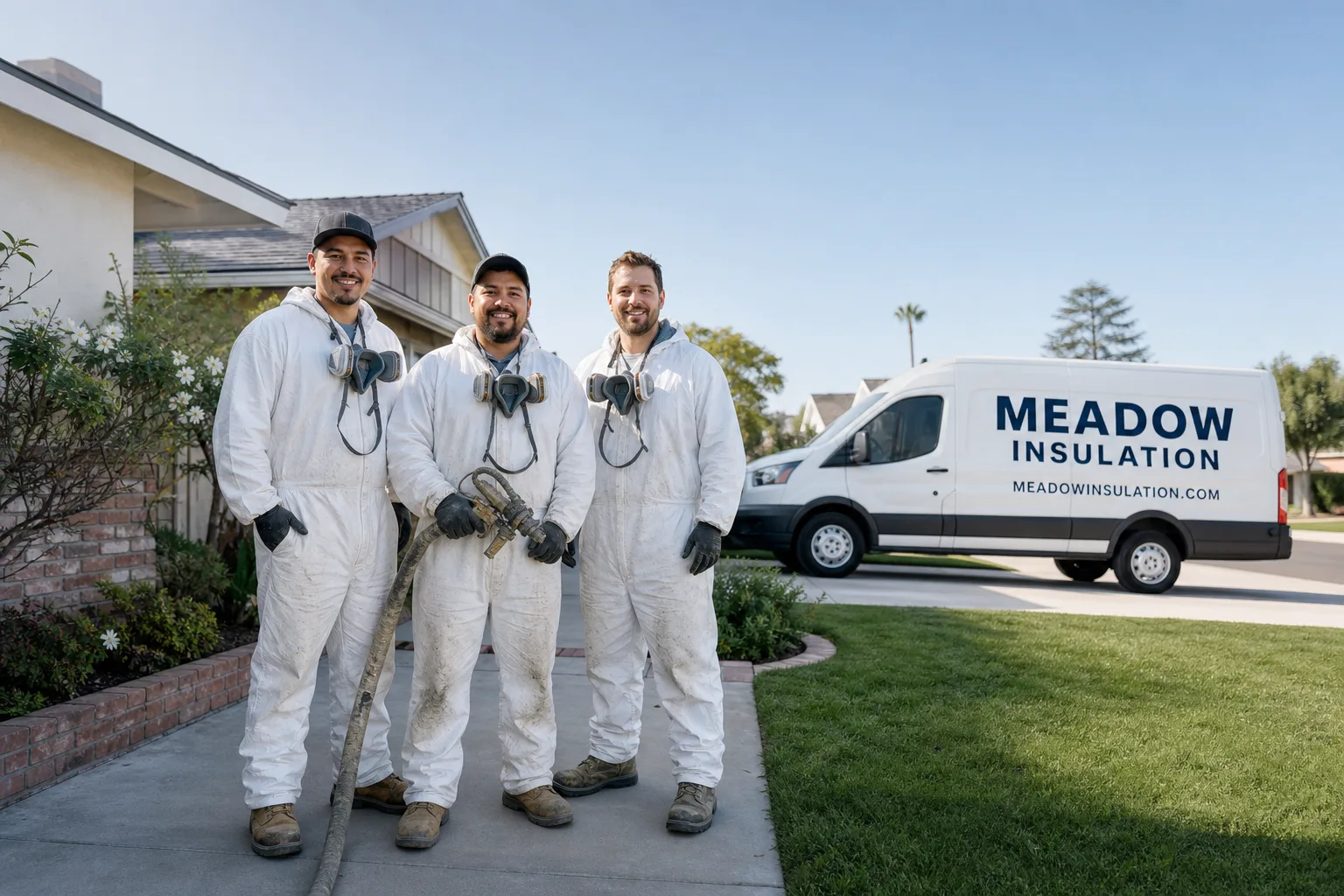
Fast, Reliable Spray Foam Insulation Across Glendora
Spray foam insulation in Glendora typically costs $2,400 – $6,800 for a full attic roof deck application, with wall cavity work running $1,800 – $4,200 depending on the square footage and whether you choose open-cell or closed-cell. Our crews work the foothill neighborhoods from the 91740 valley floor up to the 91741 hillside pockets, and we know the difference between a citrus-era bungalow and a custom home built into the slope. If your energy bills climb every August and certain rooms never hold temperature, the problem is usually air movement through unsealed framing, not your HVAC. Call (833) 589-8312 for a free estimate and we’ll tell you exactly what your home needs, not what’s easiest to install.
Why Meadow Insulation Is Glendora’s Preferred Spray Foam Insulation Company
Glendora homeowners call us because we match the foam to the structure. A 1960s tract home off Lone Hill Avenue needs a different spec than a hillside custom off Sierra Madre Boulevard, and we don’t pretend otherwise. Spray Foam Insulation is a technique, not a product, and the right choice depends on your wall assembly, your roofline, and whether you’re fighting solar gain or Santa Ana ember intrusion.
Our team is authorized to install Icynene and Demilec spray foam, which means we’re not limited to a single manufacturer’s lineup. Allen Drummond, our owner, built Meadow Insulation around product neutrality: eight manufacturers across every major insulation category, so the recommendation comes from your home’s needs. That matters in Glendora, where the housing stock ranges from wood-framed mid-century tract homes to complex hillside custom builds. We also carry mineral wool and fiberglass options through Knauf, Rockwool, and CertainTeed for projects where foam isn’t the right call.
Spray Foam Wall Insulation in Glendora
Spray Foam Wall Insulation in Glendora means injecting foam into existing wood-framed wall cavities or applying it to open stud bays during a remodel. Most mid-century homes in the 91740 and 91741 ZIP codes were built with empty wall cavities: no insulation, no air barrier, nothing between the drywall and the stucco except framing and dead air. When inland heat drives wall surface temperatures past 130°F in July, that dead air conducts heat straight into living spaces. Open-cell foam fills those cavities completely, cutting both conductive heat gain and the air movement that carries attic-heated air into wall assemblies.
Cavity Injection for Existing Walls
We drill small access holes from the interior or exterior, inject foam into each stud bay, and patch cleanly. Cost runs $2.80 – $4.50 per square foot of wall area in Glendora, with whole-home retrofits typically between $4,500 and $9,800. Most jobs finish in one to two days.
Closed-Cell for Foothill Exposures
Homes along the base of the San Gabriels face wind-driven embers that flat-valley houses never see. Closed-cell foam adds structural rigidity and acts as a secondary air and ember barrier inside wall cavities. For slopeside properties, we often specify Demilec closed-cell on the windward wall assembly and pair it with proper flashing and sealing at the sheathing plane.
Rim Joist Spray Foam in Glendora
Rim Joist Spray Foam in Glendora targets the band board where your floor framing meets the foundation wall, one of the leakiest parts of any raised-floor home. Older Glendora tracts, especially the citrus-era bungalows and 1950s ranches throughout the 91740 valley floor, have rim joists that were never sealed. In winter, cold valley air moves through the rim into the crawlspace and up through the floor. In summer, the stack effect reverses and pulls superheated attic air down through wall cavities. A two-inch layer of closed-cell foam across the rim joist area seals that boundary permanently.
Crawlspace Rim Air-Sealing
We remove any fiberglass stuffed into the rim, clean the surfaces, and apply closed-cell foam from the sill plate to the subfloor. Typical Glendora homes run $1,200 – $2,600 for full perimeter rim sealing, depending on crawlspace access and joist spacing. The work also blocks rodent and pest entry points, which matters in foothill neighborhoods where critters move down from the mountains during dry seasons.
Basement and Garage Rim Details
For homes with partial basements or attached garages on slopes, rim joist sealing ties into the wall insulation plan. We treat the rim as part of the thermal boundary, not a separate afterthought. Closed-cell foam here also resists moisture, which matters in Glendora’s older foundation systems where seasonal soil shifts create minor cracking and humidity movement.
Trusted Brands We Service in Glendora
We install Icynene and Demilec spray foam systems, which covers both open-cell and closed-cell applications across Glendora’s mix of housing types. Icynene’s open-cell product works well for attic roof decks and interior wall cavities where fire-blocking isn’t the priority. Demilec’s closed-cell line provides the density and air-sealing we need on foothill exteriors and rim joists. We also carry Rockwool and Knauf products for Glendora customers who need mineral wool or fiberglass in specific assemblies where foam isn’t appropriate. Parts, foam, and equipment are stocked locally, not shipped from out of state, so we can turn estimates around quickly and keep schedules tight even during peak summer demand.
Common Spray Foam Insulation Problems We See in Glendora Homes
- Vented attics with no air-sealing on top plates: Mid-century tract homes in the 91740 valley floor were built with vented attics and zero air sealing. We regularly find top plates leaking conditioned air into the attic, which is why our Spray Foam Insulation team always seals penetrations before spraying any foam. Without that step, you’re just insulating over the leaks.
- Santa Ana wind pushing ember-laden air through wall cavities: Foothill-edge homes along the San Gabriels face wind-driven ember intrusion that flat-valley cities like Covina never experience. Open wall cavities with no air barrier let smoke and embers get pulled through gaps around outlets, windows, and sheathing seams. Closed-cell foam at the wall plane cuts that pathway dramatically.
- Thin or poorly cured foam on complex hillside rooflines: Hillside custom homes have dormers, valleys, and cantilevered sections where foam applied too thin can shrink and pull away as it cures. We see hidden air channels behind finished surfaces on homes that were sprayed by crews without experience on complex geometry. Matching the foam pass thickness to the substrate temperature during inland heat swings is the difference between a permanent seal and a hidden failure.
- Old batt insulation in rim joists and crawlspace ceilings: Many Glendora homes still have fiberglass stuffed into rim joist cavities, where it sags, absorbs moisture, and does almost nothing for air movement. When we pull it out, homeowners see daylight through the framing. Replacing it with closed-cell foam stops the air, not just slows it.
Pricing for Spray Foam Insulation in Glendora, CA
Expect to pay $2,400 – $6,800 for a full attic roof deck spray foam application on a typical Glendora single-story, with two-story tract homes running toward the higher end. Wall cavity injection runs $2.80 – $4.50 per square foot, and rim joist sealing typically lands between $1,200 and $2,600. Hillside custom homes with complex geometry and difficult access run 15 – 30% higher because of slower work and greater material waste. Closed-cell foam costs $1.15 – $1.75 per board foot installed, while open-cell runs $0.50 – $0.90. We give a written line-item estimate before any work starts, and the price we quote is the price you pay. Call (833) 589-8312 to schedule a free assessment.
We Also Serve Cities Near Glendora
Meadow Insulation works throughout the San Gabriel Valley, including Citrus, Covina, Irwindale, and La Verne. If you’re in a neighboring city and dealing with the same inland heat, aging tract housing, or foothill wind exposure, we can help. Our Spray Foam Insulation expertise applies just as directly to a Covina ranch as it does to a Glendora hillside custom.
Serving Glendora, CA — Our Local Coverage Area
We’re based in the Glendora area and know this community well. Use the map below to see our service coverage — if you’re nearby, we can almost certainly help.
FAQs About Spray Foam Insulation in Glendora
Spray foam makes sense because a 1960s Glendora tract home has wood-framed walls and a vented attic with no air-sealing, which means batt insulation alone won’t stop the air movement that drives your August attic temps past 140°F. Open-cell foam applied to the attic roof deck seals the top plates, penetrations, and the roofline itself, creating a continuous air barrier that batt can’t replicate. The cost is higher up front, but the cooling savings and comfort difference in Glendora’s inland heat typically pay for the upgrade within five to seven years. Call (833) 589-8312 for a walkthrough of your specific attic and a line-item quote.
Yes, closed-cell spray foam acts as a secondary ember and air barrier inside wall cavities and along rim joists, which reduces the pathways wind-driven embers use to reach flammable framing. We specify Demilec closed-cell on the windward wall assembly of foothill-edge homes along the San Gabriels, paired with proper flashing and sheathing details. The foam also stiffens the wall plane, which helps during high-wind events. It’s not a substitute for fire-resistant exterior materials, but it closes the interior paths that let smoke and embers get pulled through gaps around outlets and framing intersections.
The right foam for a hillside custom home is usually a hybrid: open-cell foam for the main attic roof deck where you need thermal performance and sound control, with closed-cell foam at the rim joists, cantilevered floors, and any wind-exposed wall cavities. Complex rooflines with dormers and valleys require careful pass thickness and surface temperature management, because inland heat swings can cause thin foam to shrink and pull away during cure. We work with both Icynene open-cell and Demilec closed-cell, so we aren’t forced into one product when the structure calls for a mixed approach.
Glendora’s hot, dry summers and occasional cold valley nights mean substrate temperatures vary widely between morning and afternoon, which affects how spray foam cures and adheres. Applying foam to a 140°F roof deck in the middle of the day can cause it to cure too fast, leading to shrinkage and delamination. Our crews work early or in stages, monitor surface temperatures with an infrared gauge, and adjust pass thickness so the foam cures properly even during heat waves. It’s a detail a lot of installers skip, and it’s why we see so many failed spray jobs from out-of-area crews on Glendora hillsides.
You don’t always need to remove old batt or blown-in insulation before spraying foam, but in older Glendora bungalows we usually recommend removing any moisture-damaged or pest-contaminated material first. Clean substrate matters for adhesion, and old fiberglass in wall cavities or rim joists often hides leaks and rodent damage that foam would seal in. We’ll assess during the estimate and tell you whether removal is necessary or whether we can spray directly over existing material. Estimates are free, and the recommendation is based on what we find in your specific home, not a generic one-size-fits-all playbook.
One More Thing About Glendora Spray Foam Work
Glendora’s foothill-edge homes face dual spray foam demands that flat-valley neighbors like Covina don’t. The same wall assembly must resist Santa Ana wind-driven ember intrusion on the fire-exposed side and block intense solar-driven attic heat on the roof line. We often specify closed-cell foam for its air-sealing and ember resistance on the windward wall plane, while using open-cell or radiant-barrier strategies on the solar-exposed roofline. That split spec isn’t something you get from a single-brand installer working off a template.
On a 1960s single-story in the 91741 citrus-era pocket, our crew found the original vented attic and wood-framed walls leaking cool air through unsealed top plates, driving August attic temps past 140°F. We applied Icynene open-cell foam to the attic roof deck and sealed the rim joists with Demilec closed-cell, then air-sealed the top plates. The homeowner reported the back bedrooms finally holding setpoint and the attic staying under 110°F even during a heat wave. That’s the kind of result we aim for on every Glendora job.
Call Meadow Insulation for Spray Foam in Glendora
If your Glendora home is fighting inland heat, Santa Ana winds, or an aging wood-framed attic, we’ll tell you exactly what’s going on and what it’ll take to fix it. No pressure, no upsell, just a clear recommendation matched to your house. Call (833) 589-8312 for a free estimate.
Written by Allen Drummond, Owner at Meadow Insulation, serving Glendora and the San Gabriel Valley.