
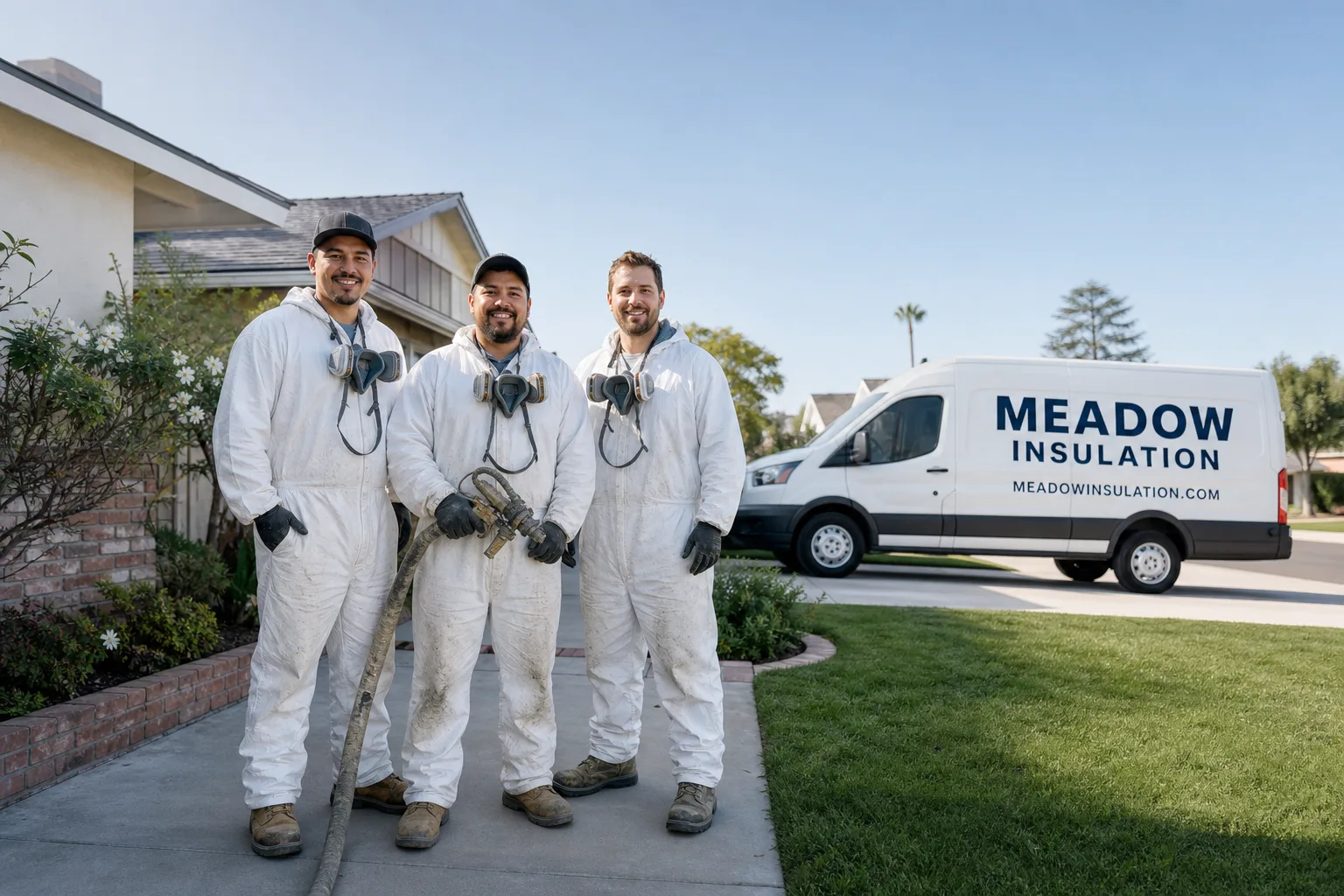
Spray Foam Insulation in Lakewood, CA: Costs, Key Considerations, and What Most Contractors Miss
Spray foam insulation in Lakewood typically runs $2.50 to $5.50 per board foot for open-cell and $3.50 to $7.50 for closed-cell, with a full garage ceiling retrofit on one of the city’s classic 1950s tract homes usually landing between $1,800 and $4,200. Most jobs are completed in a single day. What separates a lasting Lakewood spray foam installation from one that fails in five years comes down to one detail most contractors overlook: ventilation.
Lakewood isn’t just another Los Angeles suburb. It’s one of America’s first planned post-WWII communities, with roughly 17,000 homes built by the Lakewood Park Company between 1950 and 1953. Those homes share a specific construction profile: shallow attics with 2×4 rafters, no soffit vents, and thin or nonexistent original insulation. If you spray foam into that structure without addressing airflow first, you’re sealing in moisture, not sealing it out. Our Spray Foam Insulation team has been working on these homes long enough to know exactly what to check before the first drop of foam leaves the gun.
Call (833) 589-8312 to speak with Allen Drummond directly about your Lakewood home.
Why Lakewood’s Original Homes Need a Different Approach to Spray Foam
Here’s what we’ve learned from working inside Lakewood’s original housing stock: the Lakewood Park Company built fast and built efficiently, which meant attics were designed for construction speed, not thermal performance. Most of these homes, whether in the Mayfair neighborhood, around Lakewood Country Club, or east of Lakewood Boulevard in the 90712 and 90713 ZIP codes, have the same shallow attic geometry. The roof pitch is low. The rafters are 2×4, not 2×6. And critically, there are no soffit vents.
This matters because spray foam on a roof deck or garage ceiling changes how moisture moves through a structure. In a vented attic, humid air rises and exits through soffit and ridge vents. In an unvented Lakewood attic, that moisture has nowhere to go. It condenses on metal surfaces: garage-door springs, roller tracks, opener chains, hinge plates. Within two to four years, homeowners start noticing rust where there was none before.
Because Lakewood’s original homes lack soffit vents and have shallow 2×4 rafters, spray foam in garages and crawl spaces must be paired with new eave venting before any foam is applied. Otherwise trapped moisture accelerates corrosion of garage-door hardware, a problem that is far less severe in neighboring inland cities with deeper attics and vented soffits. Signal Hill and Bellflower homes from the same era sometimes have vented attics. Lakewood’s original tract houses, by and large, do not.
Why Meadow Insulation Is Lakewood’s Preferred Spray Foam Insulation Company
We don’t believe in one-size-fits-all insulation, and Lakewood is exactly the kind of market that proves why. A house on a 1951 slab foundation near Carson Street has different needs than a 1960s addition near Studebaker Road or a remodeled home near Heartwell Park. We approach each structure on its own terms, choosing from eight manufacturers rather than pushing whatever product happens to be on the truck.
Allen Drummond leads our spray foam work personally. He’s spent years studying how open-cell and closed-cell foam perform in Southern California’s coastal climate zones, and he’s the reason we specify different foam types for different applications. A garage ceiling in Lakewood gets closed-cell for its moisture resistance and structural rigidity. A crawl space gets open-cell for its breathability and cost-effectiveness. The wrong call either way shortens the life of the job.
Our response time to Lakewood is typically same-day or next-day for estimates. We cover all four Lakewood ZIP codes: 90711, 90712, 90713, and 90714. When you call, you’re not routed through a call center. You talk to the person who will walk your attic.
We’re authorized to install products from Owens Corning, Johns Manville, Knauf, Rockwool, CertainTeed, Icynene, Demilec, and GreenFiber. That range matters in a city with such a uniform housing stock, because the right material choice is often what separates a job that performs from one that just fills space.
What Lakewood Homeowners Tell Us
The most common call we get from Lakewood goes something like this: “The garage is unbearable in summer, the bedroom above it never cools down, and I think I can smell moisture.” That’s the classic signature of an original Lakewood Park Company home with an uninsulated, unvented garage ceiling. The fix is rarely just foam. It’s foam plus ventilation plus air sealing at the rim joist.
Crawl Space Spray Foam Insulation in Lakewood
Crawl Space Spray Foam Insulation in Lakewood addresses the damp, unconditioned space under many of the city’s older homes, where uncovered dirt floors and open foundation vents let humid coastal air circulate freely. Most Lakewood crawl spaces we see are shallow, poorly vented, and partially filled with deteriorated fiberglass batts that homeowners assumed were still working. A typical crawl space encapsulation with closed-cell spray foam in Lakewood runs $2,800 to $6,500 depending on square footage and access.
In Lakewood’s coastal-influenced climate, crawl space moisture isn’t just a comfort issue. It’s a corrosion issue. Humid air rises from the crawl space into the garage through plumbing and electrical penetrations. If the garage is spray foamed without addressing the crawl space below it, you’ve essentially trapped that moisture against the garage floor framing and any metal hardware in its path.
Sealing the Rim Joist
The rim joist is where floor framing meets the foundation wall, and it’s the single largest air leak in most Lakewood crawl spaces. We use closed-cell spray foam here because it creates an air seal and a vapor barrier in one pass.
In an original Lakewood Park Company home, the rim joist is often rough-sawn lumber with gaps where it meets the sill plate. Foam fills those voids completely, which is something fiberglass batts physically cannot do.
Moisture Control Before Foam
If a Lakewood crawl space has standing water or active seepage, foam goes in only after drainage is addressed. Spray foam over a wet crawl space is a recipe for trapped moisture and wood rot.
We check for this on every Lakewood crawl space job before we quote. Many crawl spaces in the 90714 ZIP code near the San Gabriel River bed carry more ground moisture than homeowners realize.
Garage Spray Foam Insulation in Lakewood
Garage Spray Foam Insulation in Lakewood is the highest-impact retrofit for the city’s original tract homes, because the garage is typically attached, unconditioned, and sits directly below or adjacent to living space. A full garage ceiling and wall spray foam job in Lakewood runs $1,800 to $4,200 for a standard one- to two-car garage, with most jobs finishing in one day.
Here’s the critical Lakewood-specific point: sealing a garage with spray foam changes the moisture dynamics of the entire attached structure. The original Lakewood Park Company attics above those garages have no soffit vents. If you foam the ceiling without adding ventilation at the eaves, you trap warm, moist air against the roof deck and everything mounted to it: springs, hinges, rollers, tracks, opener chains. The salt in Lakewood’s coastal air accelerates the corrosion once that moisture is trapped.
Ventilation Comes First
On nearly every Lakewood garage spray foam job, we cut and install proper eave venting before any foam touches the ceiling. This is not optional in these homes. It’s the single step that separates a job that lasts from one that rusts out garage-door hardware in three years.
The original Lakewood Park Company homes often have a shallow attic with 2×4 rafters and no soffit vents, so the first order of business on most jobs is cutting and installing proper eave venting before any insulation goes down.
Closed-Cell for Garage Ceilings
For garage ceilings below bedrooms, we specify closed-cell foam for its higher R-value per inch and its moisture resistance. Closed-cell acts as a vapor barrier, which is essential in Lakewood’s salt-adjacent air.
On a 1951 Lakewood Park Company home near Mayfair Park, our crew found the original garage-door springs and hinges heavily corroded from salt air and attic moisture. We installed Owens Corning spray foam in the garage ceiling and walls, but first cut and installed proper eave venting to improve airflow – a step we now take on nearly every Lakewood spray foam job because the original attics have no soffit vents.
Trusted Brands We Service in Lakewood
We’re authorized installers for eight insulation manufacturers, and when it comes to spray foam in Lakewood, we lean on two of them: Icynene for open-cell applications and Demilec for closed-cell. Both are industry-recognized brands with proven track records in coastal climate zones. For Lakewood customers whose projects also involve batt insulation, we keep Owens Corning and Johns Manville stock available for quick turnaround. The right insulation for your home’s structure, not just the easiest one to install.
Common Spray Foam Insulation Problems We See in Lakewood Homes
- Salt-air corrosion of garage-door hardware after foam is installed without ventilation. Lakewood’s proximity to the Long Beach coastline means airborne salt settles on springs, hinges, and fasteners. When foam seals a garage too tightly without new eave venting, moist salty air has no exit and corrosion accelerates significantly.
- Rusted roller tracks and opener chains within a few years. Original no-soffit-vent attics cause spray foam on the roof deck to trap moisture. That moisture condenses on metal garage-door components, and we’ve seen opener chains rust to the point of binding in as little as three years.
- Incomplete coverage in thin 2×4 walls with stucco exteriors. Lakewood’s original homes have uninsulated 2×4 framing with stucco. Blown-in foam can leave thermal gaps in these walls, and repeated expansion and contraction from uneven temperatures stresses garage-door hardware over time.
- Foam applied directly to roof decks without air gap. In shallow Lakewood attics, closed-cell foam on the underside of the roof deck can trap moisture against the sheathing if ventilation isn’t addressed first. We see evidence of this in peeling roof decking and rusted fasteners on older foam jobs done by generalist contractors.
Pricing for Spray Foam Insulation in Lakewood, CA
Here’s what Lakewood homeowners can expect to pay as of 2025. Open-cell spray foam runs $2.50 to $5.50 per board foot installed. Closed-cell runs $3.50 to $7.50 per board foot. A typical garage ceiling in one of Lakewood’s original one-car garages: $1,800 to $2,800. A two-car garage with walls: $2,500 to $4,200. A full crawl space encapsulation: $2,800 to $6,500. Rim joist sealing on a typical Lakewood tract home: $800 to $1,800.
What drives cost in Lakewood specifically is the ventilation work. If your home still has original construction with no eave vents, expect venting installation to add $400 to $1,200 to the job. It’s not optional. Skipping it saves money today and costs you a rusted garage-door system in a few years. Call (833) 589-8312 for a free on-site estimate. Estimates are free and come with no pressure.
We Also Serve Cities Near Lakewood
Our spray foam crews work throughout southeastern Los Angeles County. In addition to Lakewood, we regularly serve Signal Hill, Bellflower, Long Beach, and Paramount. Each city has its own housing quirks. Lakewood’s original tract homes are unique, but we apply the same product-neutral approach and pre-foam ventilation checks everywhere we work.
Serving Lakewood, CA — Our Local Coverage Area
We’re based in the Lakewood area and know this community well. Use the map below to see our service coverage — if you’re nearby, we can almost certainly help.
FAQs About Spray Foam Insulation in Lakewood
Spray foam seals a garage, which traps moist air inside unless ventilation is added first. In Lakewood’s original no-soffit-vent homes, that trapped moisture condenses on springs, hinges, and opener chains, and salt from the coastal air accelerates the rust. The fix is proper eave venting before foam, which is standard on our Lakewood jobs. Call (833) 589-8312 to have your garage inspected.
Yes. The original Lakewood Park Company homes were built without soffit vents, and spray foam in those shallow 2×4-rafter attics will trap moisture against the roof deck and garage-door hardware. We install eave venting on nearly every Lakewood spray foam job before applying any material.
We use Icynene open-cell and Demilec closed-cell spray foam for Lakewood projects. Both are industry-recognized brands with proven performance in coastal climates. For related batt work, we also install Owens Corning and Johns Manville products.
Salt air doesn’t directly degrade cured spray foam, but it accelerates corrosion of metal components in and around the insulated space: garage-door springs, hinges, tracks, fasteners. When foam traps moist salty air against those surfaces, corrosion that might take a decade inland happens in a few years here. Ventilation and corrosion-resistant hardware are the answer.
Foam alone can’t stop it, and in a poorly vented Lakewood garage, foam can make it worse. What protects your opener chain is ventilation plus foam, not foam alone. We also recommend inspecting garage-door hardware for salt corrosion before any spray foam work, since sealing in already-rusted components just locks in the problem. Call (833) 589-8312 for a free assessment.
Contact Meadow Insulation for Spray Foam in Lakewood
If you live in Lakewood, from Mayfair to College Estates to the Lakewood Country Club area, and your garage is hot, your energy bills are climbing, or you’ve noticed rust on your garage-door hardware, we can help. Allen Drummond and the Meadow Insulation team will inspect your attic, your garage, and your crawl space, then recommend the right product from eight trusted brands. No pressure, no upsells. Call (833) 589-8312 today for a free estimate, or reach out to schedule an inspection. We serve all Lakewood ZIP codes: 90711, 90712, 90713, and 90714.
Written by Allen Drummond, Owner at Meadow Insulation, serving Lakewood and surrounding cities with spray foam, attic, and blown-in insulation.