Fast, Reliable Attic Insulation Across South San Jose Hills
Attic insulation in South San Jose Hills costs between $1,450 and $3,800 for a typical single-story ranch home, with blown-in cellulose running $1,450 – $2,400 and full replacement with air sealing landing between $2,600 and $3,800. Most jobs in the 91792 ZIP finish in one day. If your attic still holds its original 1950s or 1960s insulation, you’re losing conditioned air through a ceiling plane that’s barely doing its job. Call (833) 589-8312 and we’ll get a truck out to your hillside tract this week.
South San Jose Hills isn’t like West Covina or Rowland Heights when it comes to attic work. The slopes change everything. Sun hits your south and west roof planes for ten or twelve hours in summer, and when the Santa Anas kick up, wind scours the exposed walls. That combination is why attics here fail differently than they do in the flatlands a mile down the hill.
Why Meadow Insulation Is South San Jose Hills’s Preferred Attic Insulation Company
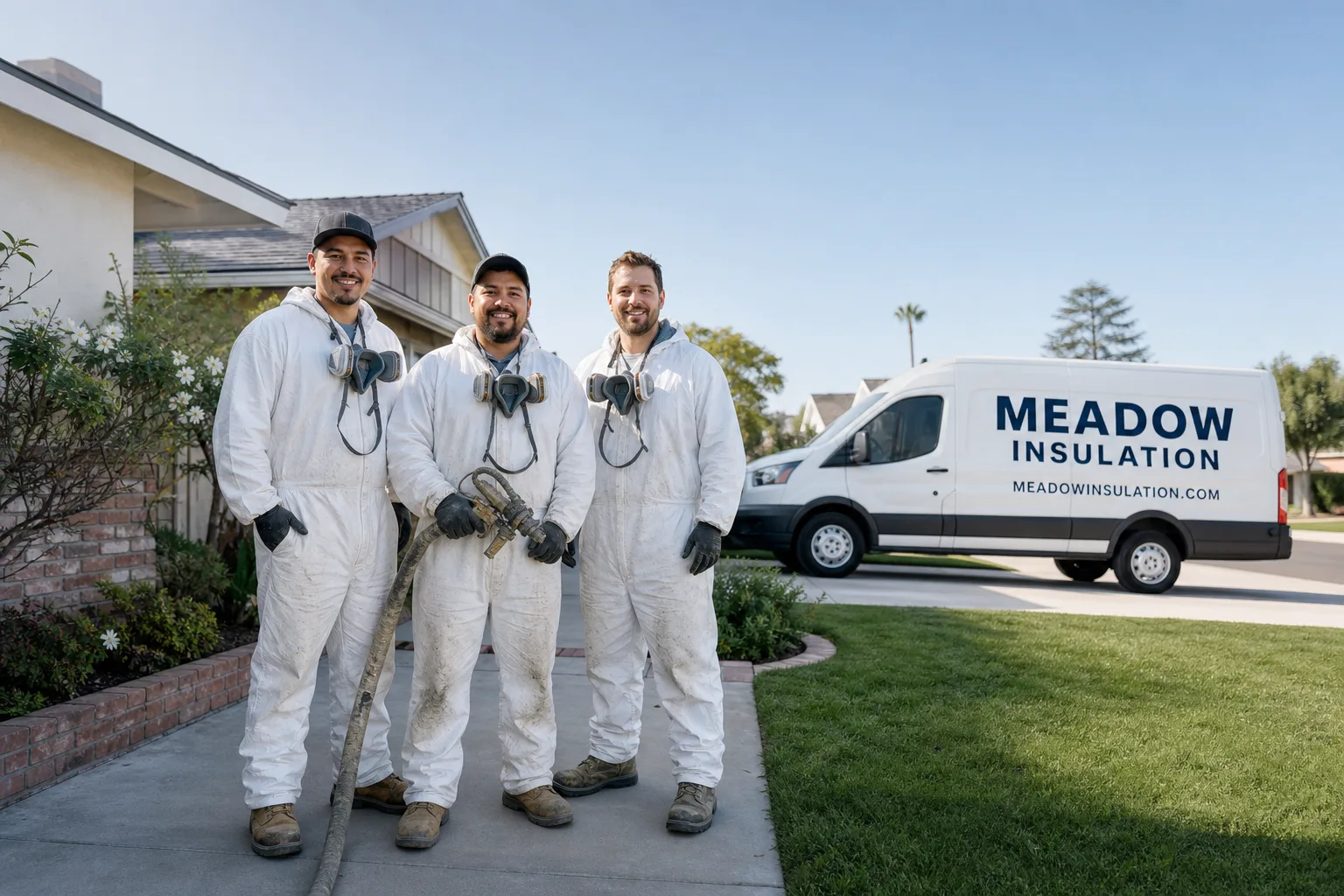
Allen Drummond runs our crews, and he’s spent years working attics in the foothill communities east of the 605. When we pull up to a home off Valley Boulevard or one of the hillside streets branching south toward the 60, we know what we’re going to find before we open the hatch. Homes in South San Jose Hills were built in the 1950s through 1970s, mostly wood-frame tract and ranch, and most have never had their attic insulation touched since the day the original contractor blew it in.
We carry a full material lineup on every truck that rolls into South San Jose Hills: Knauf batts, Rockwool mineral wool, GreenFiber loose-fill, CertainTeed, and spray foam from both Icynene and Demilec. That means we don’t show up, look at your attic, and then tell you we need to come back next week with the right product. We bring the product range with us. For a hillside tract home off 91792, that usually means one trip, not three.
Our reviews from South San Jose Hills homeowners consistently mention the same thing: the crew showed up when they said they would, explained what was actually wrong in the attic, and didn’t push a more expensive system than the house needed. That’s the standard. We’re an Attic Insulation specialist, not a general contractor juggling six trades. Attics are what we do.
Attic Ventilation in South San Jose Hills
Attic Ventilation in South San Jose Hills is not optional if you want your insulation to last through the summer heat. The sun pounds overhead, the attic air hits 140°F or higher by mid-afternoon, and without proper venting, that heat radiates down through your ceiling for hours after sunset. In this community, ventilation work usually means clearing old bird and rodent nests from existing soffit vents, cutting new intake openings along the eaves, and checking that ridge or box vents are actually moving air, not just decorating the roof.
Most homes here have low-pitch roofs and minimal eave overhang, which is a tight space to work in. The job typically runs $450 – $1,100 for a standard ranch, depending on how much of the existing venting is still functional and whether we need to add baffles at the eaves to keep insulation from blocking airflow. That’s a morning job for us.
Signs Your Attic Is Holding Heat
If your upstairs hallway is 10 degrees warmer than the rest of the house at 9 p.m., heat is sitting in that attic with nowhere to go. We see this constantly in South San Jose Hills homes where the original roof vents were either never installed properly or have been painted over and sealed by successive roof coatings. The fix is straightforward. More air moving through the attic means less heat pushing down into the ceiling insulation.
Airflow Before Insulation, Always
We don’t blow insulation into an unvented attic. That’s a recipe for trapped heat degrading your new material within a few seasons. Before any blown-in job in South San Jose Hills, we inspect the gable, ridge, and soffit venting and tell you honestly what’s reusable. If the venting is shot, we address it first. That sequencing matters more on hillside lots where one roof plane bakes all afternoon.
Radiant Barrier in South San Jose Hills
Radiant Barrier in South San Jose Hills is a heat reflector stapled to the underside of the roof decking, and in this climate it performs better than almost anywhere else in Los Angeles County. The physics are simple: a radiant barrier reflects heat back toward the roof instead of letting it radiate into the attic. On a south or west-facing slope with direct sun exposure, a fresh radiant barrier can cut attic temperatures by 20 to 30 degrees on a July afternoon.
Radiant barrier installation here runs $1,200 – $2,800 for a typical 1,200 to 1,800 square foot single-story home. The spread depends on roof pitch, accessibility, and whether we’re working around duct runs or ceiling joist interference. Older homes with tight attics and low headroom take longer, and we price that honestly up front.
The Sun-Slope Problem
We open a lot of attics in the hillside tracts off 91792 and find radiant barrier that was installed in the 1980s or 1990s now chalked and flaking off the south slope. When the foil surface oxidizes and separates from the backing, it stops reflecting heat. The homeowner still has the product installed, but it’s not doing anything. That’s why replacement jobs here often deliver a bigger comfort difference than the homeowner expected.
Do You Already Have Loose-Fill?
Yes, you can install a radiant barrier even when the attic floor is full of loose-fill. They work at different steps in the heat-transfer chain. The barrier stops the sun’s heat from entering the attic; the loose-fill stops whatever residual heat remains from pressing through the ceiling. In South San Jose Hills, the south and west slopes need the barrier more than the north slope ever will. We won’t sell you a full-coverage job when two roof planes are doing all the work.
Trusted Brands We Service in South San Jose Hills
Meadow Insulation installs attic insulation products from eight manufacturers, and we stock the ones that matter for South San Jose Hills jobs: Knauf batts for standard cavity fill, Rockwool for fire-resistance and sound control, GreenFiber cellulose for blown-in work, and Icynene spray foam for air-sealing the ceiling plane on penetrations and knee walls. We’re authorized to install each one, which matters. A single-brand shop will sell you whatever they carry. We match the product to your roof orientation, your venting, and your budget, not to what’s in the warehouse. For most hillside ranch homes here, GreenFiber blown-in plus a fresh radiant barrier on the south and west slopes is the right combination.
Common Attic Insulation Problems We See in South San Jose Hills Homes
- Settled and dust-loaded original batts. Homes built in the 1950s through 1970s typically still have their original thin fiberglass batts and loose-fill. Forty or fifty years of heat, dust, and rodent traffic leave it compressed to a fraction of its original R-value, with the top plate and knee walls nearly bare under the hottest roof slopes.
- Sun-degraded radiant barriers on south and west slopes. In the hillside tracts off 91792, we regularly find radiant barrier that has oxidized, chalking, and flaked away exactly where the roof takes the most afternoon sun. Where it’s gone, attic heat gain peaks hard.
- Wind-driven heat loss through unsealed penetrations. Santa Ana events scour these exposed hillside walls. If your ceiling plane has gaps around can lights, bath fans, or the attic access hatch, those winds press hot air out through every opening, dragging your conditioned air with it, and the insulation along those gaps is bypassed completely.
- Rodent nesting in neglected attic spaces. The hillside brush and unincorporated lots mean packrats and mice find their way into attics here more often than in the tightly packed neighborhoods down the hill. Nesting destroys insulation patches and creates urine-saturated zones that need removal, not just topping up.
Pricing for Attic Insulation in South San Jose Hills, CA
For South San Jose Hills specifically, here’s what we quote in 2026. A standard blown-in cellulose job over existing settled insulation runs $1,450 – $2,100 for a typical 1,100 to 1,600 square foot ranch. Adding air sealing at the ceiling plane and replacing whatever’s been contaminated pushes total replacement to $2,600 – $3,800. Radiant barrier installation runs $1,200 – $2,800 depending on roof pitch and attic access. Attic ventilation work runs $450 – $1,100. The single biggest cost factor is whether your existing material can stay in place or needs full removal. Second is roof pitch. Steeper hillside lots take longer, and we price that up front. Call (833) 589-8312 and Allen can walk you through which number applies to your house. Estimates are free.
We Also Serve Cities Near South San Jose Hills
Our trucks make runs into Valinda, Walnut, West Covina, and Rowland Heights every week, so we’re familiar with how the housing stock changes from the unincorporated hills down into the basin. If you’re in a neighboring community, we can help. But if you’re reading this from South San Jose Hills, you’re in the community we know best: sun-baked slopes, Santa Ana winds, and attics that need real work, not just a top-up.
Serving South San Jose Hills, CA — Our Local Coverage Area
We’re based in the South San Jose Hills area and know this community well. Use the map below to see our service coverage — if you’re nearby, we can almost certainly help.
FAQs About Attic Insulation in South San Jose Hills
South San Jose Hills attics lose performance faster because they’re exposed on unincorporated foothill slopes where two forces work together: long, direct summer sun that bakes the roof deck from mid-morning to sunset, and Santa Ana wind events that scour exposed walls and press hot air through every gap in the ceiling plane. Homes in the LA basin below get some marine-layer cooling and far less sustained wind. Here, the heat load and the wind-driven air movement mean insulation settles sooner, radiant barriers degrade faster on south and west slopes, and unsealed penetrations do more damage. If your home hasn’t had its attic inspected in ten years, assume the material is underperforming. Call (833) 589-8312 and we’ll confirm what’s actually happening up there.
Yes, most of the time. We stage everything on the truck before we arrive in South San Jose Hills, because we know hillside access means narrow streets, tight driveways, and no convenient loading zone. For a typical single-story ranch needing blown-in insulation plus air sealing, one visit is standard. For full removal and replacement with a radiant barrier on multiple slopes, the job may take a full day, but we still bring everything we need the first time. If your attic has tight headroom or steep roof access, we account for that in the quote and use ladders and staging that work safely on a slope. Call (833) 589-8312 to confirm your home qualifies for a single-day install.
Possibly. Loose-fill insulation slows heat moving down through your ceiling, but it does not stop the sun from heating the attic cavity in the first place. On south and west facing slopes in South San Jose Hills, a radiant barrier does that job. The two work in sequence: the barrier reflects heat upward and out, and the loose-fill handles whatever still presses through. If your attic already has a decent depth of loose-fill but the roof still radiates heat into the upstairs rooms by early evening, a radiant barrier on the sun-facing slopes is often the piece that’s missing. Call (833) 589-8312 for a slope specific quote. Free estimates.
We install attic insulation from Knauf, Rockwool, CertainTeed, Icynene, and GreenFiber, plus our other authorized manufacturer lines. For most South San Jose Hills ranch homes, we recommend GreenFiber blown-in cellulose for the attic floor and a radiant barrier for the sun-exposed roof slopes, with Knauf or Rockwool batts for cavity fill where needed. We’re not tied to one brand, so the recommendation is based on your home’s structure and exposure, not inventory. Call (833) 589-8312 and Allen Drummond can explain which product fits your attic best.
Santa Ana winds make South San Jose Hills attics lose conditioned air through the ceiling plane much faster than calm-weather neighborhoods. When gusts hit 40 or 50 mph on exposed hillside lots, they create pressure differences that pull heated air out of the home through every opening: can lights, bath fan housings, the attic access hatch, and electrical penetrations. If those gaps aren’t air-sealed, the insulation you paid for is being bypassed whenever the wind kicks up. That’s why we always include air sealing as part of any attic insulation replacement or top-up here. Call (833) 589-8312 to schedule an inspection before the next wind event.
Written by Allen Drummond, Owner at Meadow Insulation, serving South San Jose Hills and surrounding foothill communities.