
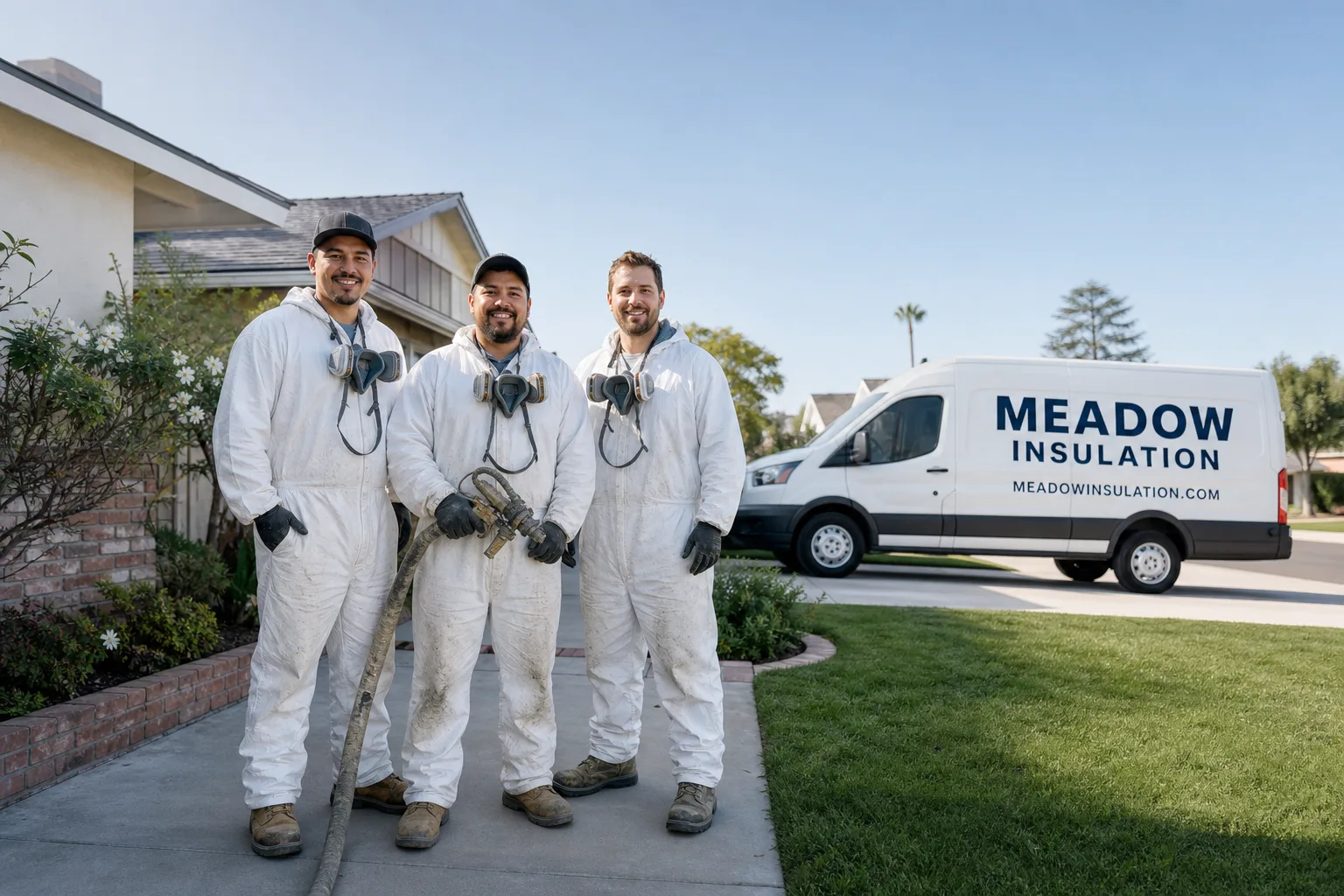
Fast, Reliable Attic Insulation Across Trabuco Canyon
Attic insulation in Trabuco Canyon, CA means dealing with attics that routinely hit 140°F in summer – a heat load that settles standard blown-in fiberglass and turns older attic hardware brittle. Most Trabuco Canyon homes we serve along Live Oak Canyon Road and Trabuco Creek Road need a combination of air-sealing, upgraded insulation, and ember-resistant ventilation to actually hold their R-value. Our crew reaches Trabuco Canyon from Villa Park in about 35 minutes, and we stock the materials that make sense for canyon homes – high-density fire-retardant blown-in products, Rockwool batts, and radiant barrier. If your attic feels like a furnace by 10 a.m., call (833) 589-8312 for a free estimate. We’ll tell you what’s actually going on up there.
Why Meadow Insulation Is Trabuco Canyon’s Preferred Attic Insulation Company
Trabuco Canyon homeowners tend to ask sharper questions than most. That’s because canyon homes – especially the 1970s through 1990s custom ranches with cathedral ceilings and exposed beams – don’t respond well to cookie-cutter insulation jobs. We’ve worked on homes off Robinson Ranch Road, up in the hills near O’Neill Regional Park, and along the creek roads where the terrain creates different temperature profiles even between neighboring properties. That local familiarity means we arrive knowing what to look for: settled batts, unvented attic spaces, legacy hatch hardware that’s seized shut, and venting that would let embers in during a Santa Ana event.
Allen Drummond leads our team with a material-agnostic approach. We’re authorized installers for Knauf, Rockwool, CertainTeed, and Icynene, which means we’re not stuck pushing one product. If your Trabuco Canyon home needs fire-resistant mineral wool, we install Rockwool. If it needs closed-cell spray foam for an unvented attic retrofit, Icynene is in our lineup. That product range matters here because canyon conditions vary by elevation and exposure – what works for a valley-floor home in 92678 may not work for a ridgeline property in 92679.
Attic Ventilation in Trabuco Canyon
Attic Ventilation in Trabuco Canyon is not a box-checking add-on – it’s the difference between an attic that stays under 120°F and one that cooks everything in it. Homes along the canyon floor and foothills deal with hot inland summers and cool nights, and without proper airflow, that heat gets trapped against the roof deck. We see it constantly: soffit vents painted over or blocked by old insulation, gable vents undersized for the attic volume, and cathedral ceiling assemblies with no air channel at all. In Trabuco Canyon, ventilation also has to account for wildfire risk. Ember-resistant vents with fine mesh screening are now standard advice for homes in the wildland-urban interface, and we won’t install anything that doesn’t meet current fire-safety standards.
Baffles, Soffit Flow, and Heat-Soaked Roof Decks
Most 1970s-1990s ranches in Trabuco Canyon either lack baffles entirely or have old cardboard baffles that have collapsed. When insulation touches the roof deck directly, airflow stops and the deck overheats. We install rigid baffles at every soffit bay before adding insulation, and on homes with shallow eaves we use low-profile baffles that still allow a real air channel. The goal is simple: intake at the eaves, exhaust at the ridge or gable.
Ember-Resistant Vents and Santa Ana Wind
Santa Ana winds in Trabuco Canyon can carry embers a mile or more. Standard box vents and open gable vents give those embers a direct route into the attic. We recommend upgrading to ember-resistant venting – either screened gable vents or California-compliant ridge vents rated for wildfire zones. It’s a modest job, usually a few hundred dollars for typical vent replacement, and it’s the single most important defensible-space upgrade you can make to the attic itself.
Radiant Barrier in Trabuco Canyon
Radiant Barrier in Trabuco Canyon addresses the specific problem that makes this canyon different: 140°F attics on summer afternoons. A radiant barrier is a reflective material, usually foil-faced, installed on the underside of the roof deck. It reflects radiant heat before it can radiate into the insulation below. In Trabuco Canyon’s hot, dry climate, a properly installed radiant barrier can drop peak attic temperatures by 20 to 30 degrees. That’s not marketing talk – it’s what we measure with infrared thermometers after installation. For most canyon homes, radiant barrier installs run $1,800 to $3,200 depending on attic size and roof geometry, and it’s often the highest-impact upgrade per dollar on older ranches.
How It Works in a Canyon Attic
Unlike insulation, which slows conductive heat, radiant barrier reflects the electromagnetic heat coming off a hot roof deck. Under a 140°F roof deck without radiant barrier, the roof radiates directly into the insulation below it. With a barrier in place, most of that heat bounces back out. We see the biggest results on homes with asphalt shingle roofs and limited natural shading – common along the open hillsides of Trabuco Canyon.
Pairing Radiant Barrier with Insulation
Radiant barrier works best as part of a complete attic treatment. We typically install it against the rafters, then ensure insulation below stays at proper depth and isn’t touching the roof deck. On a 1980s split-level off Live Oak Canyon Road, our crew found original one-piece attic hatch hardware seized and standard fiberglass batts compressed to half their depth after years of 140°F summer cycles. We replaced the hatch hardware, air-sealed the top plates, installed R-38 high-density fire-retardant blown-in insulation with ember-resistant vents, and added a radiant barrier – dropping peak attic temps and restoring the home’s thermal envelope. That’s the standard sequence for most Trabuco Canyon attics we open up.
Trusted Brands We Service in Trabuco Canyon
We install and service insulation from Knauf, Rockwool, CertainTeed, and Icynene, and we keep the materials Trabuco Canyon homes actually need in local stock rather than special-ordering from a warehouse across the county. Rockwool’s mineral wool is a frequent recommendation for canyon homes with wildland exposure – it doesn’t burn and it doesn’t settle under heat cycling. Knauf and CertainTeed give us solid fiberglass options when budget matters and the attic is vented properly. Icynene covers closed-cell and open-cell spray foam for unvented cathedral ceiling retrofits. Having all of them on the truck means we show up with the right product for the structure, not the one product we happen to sell. That’s the whole point.
Common Attic Insulation Problems We See in Trabuco Canyon Homes
- Settled blown-in fiberglass under 140°F attic heat. Homes along Live Oak Canyon Road and Trabuco Creek Road routinely see loose-fill settle to half its installed depth within a decade. The heat breaks down the material’s loft, and R-value drops with it. We pull samples and show homeowners exactly what they’re working with.
- Seized legacy attic hatch hardware. Heat cycling, not rust, is the usual culprit. The original one-piece or early sectional hatch hardware from the 1980s seizes or warps, which means the attic never gets inspected and the air seal at the opening leaks year-round.
- Unvented attics in 1970s-1990s custom ranches. Many of these homes were built with trapped-rafter cathedral ceilings and no continuous air channel. Without baffles and proper venting, both the insulation and the roof deck degrade. Closed-cell spray foam is often the most practical retrofit here.
- Compressed and contaminated batts after wildlife or ember intrusion. Canyon wildlife and wind-blown debris both find their way into attics. We regularly pull batts that are matted, soiled, or shredded – insulation that stopped performing years ago but never got looked at because the hatch wouldn’t open.
Pricing for Attic Insulation in Trabuco Canyon, CA
A typical attic insulation top-up in Trabuco Canyon runs $1,200 to $2,400 for an average 1,500 to 2,000 square foot home, depending on existing depth and whether baffles and air-sealing are needed. Full attic insulation replacement with R-38 blown-in runs $2,800 to $5,500. Radiant barrier install sits in the $1,800 to $3,200 range. Spray foam for unvented cathedral ceilings is $4,000 to $9,000 depending on square footage and whether it’s open-cell or closed-cell. What changes the number most is access: steep canyon lots, tight attic hatches, and rat runs through exposed beam ceilings all add labor time. We give free estimates with a straight line-item breakdown so you know exactly what you’re paying for. Call (833) 589-8312 to get yours.
We Also Serve Cities Near Trabuco Canyon
Meadow Insulation handles Attic Insulation work throughout the canyon corridor and surrounding foothills. If you’re in Rancho Santa Margarita, Foothill Ranch, Portola Hills, or Coto De Caza, we cover those areas too. Learn more about Attic Insulation in Trabuco Canyon on our city page.
Serving Trabuco Canyon, CA — Our Local Coverage Area
We’re based in the Trabuco Canyon area and know this community well. Use the map below to see our service coverage — if you’re nearby, we can almost certainly help.
FAQs About Attic Insulation in Trabuco Canyon
Live Oak Canyon Road sits in a stretch of the canyon where summer attic temperatures consistently hit 140°F, which causes standard blown-in fiberglass to settle and lose loft much faster than it does in shaded or lower-elevation areas. The heat is relentless and the canyon walls trap it. The fix is high-density, fire-retardant blown-in insulation at proper depth, plus radiant barrier to cut the radiant load before it reaches the insulation. If your home is on or near Live Oak Canyon Road, call (833) 589-8312 and we’ll inspect what’s actually up in your attic.
Yes, in most cases we can. The standard approach for unvented cathedral ceilings in Trabuco Canyon is closed-cell spray foam applied to the underside of the roof deck from inside the attic or through strategic access points. This creates an air and thermal barrier in one step without removing roofing. Icynene closed-cell foam is our usual recommendation for these structures. We have done several of these retrofits on 1980s ranches in the canyon, and call (833) 589-8312 to find out if your specific ceiling assembly qualifies.
Wildfire risk means we will not install standard plastic or foam vents that melt or admit embers, and we steer canyon homeowners toward mineral wool products like Rockwool that don’t burn. The dry fall winds also make proper air-sealing more important, because dust and ember intrusion follow any gap in the attic envelope. Insulation choices in Trabuco Canyon have to serve two masters: thermal performance and fire survivability. We recommend products that handle both.
If the original one-piece hatch from the 1970s or 1980s still seals flat and the hardware opens with normal effort, we’ll clean it, add weatherstripping, and leave it. If the hardware is seized, warped, or the hatch frame is leaking air, retrofit is the better call. A new insulated hatch panel with positive-latch hardware runs $250 to $600 installed and is usually part of a full attic insulation project in Trabuco Canyon. The air seal at the hatch matters as much as the insulation itself.
R-38 is the practical target for vented attics in Trabuco Canyon, and R-30 is the minimum we would consider acceptable for a heated home in this climate. For cathedral ceilings, closed-cell spray foam provides R-value per inch that outperforms fiberglass in constrained rafter bays, often landing between R-21 and R-38 depending on cavity depth. The heat loads here mean under-insulating is expensive in ways you feel every summer afternoon. Call (833) 589-8312 for a free consultation and we’ll match an R-value to your specific roof assembly.
Written by Allen Drummond, Owner at Meadow Insulation, serving Trabuco Canyon and surrounding Orange County foothill communities.