
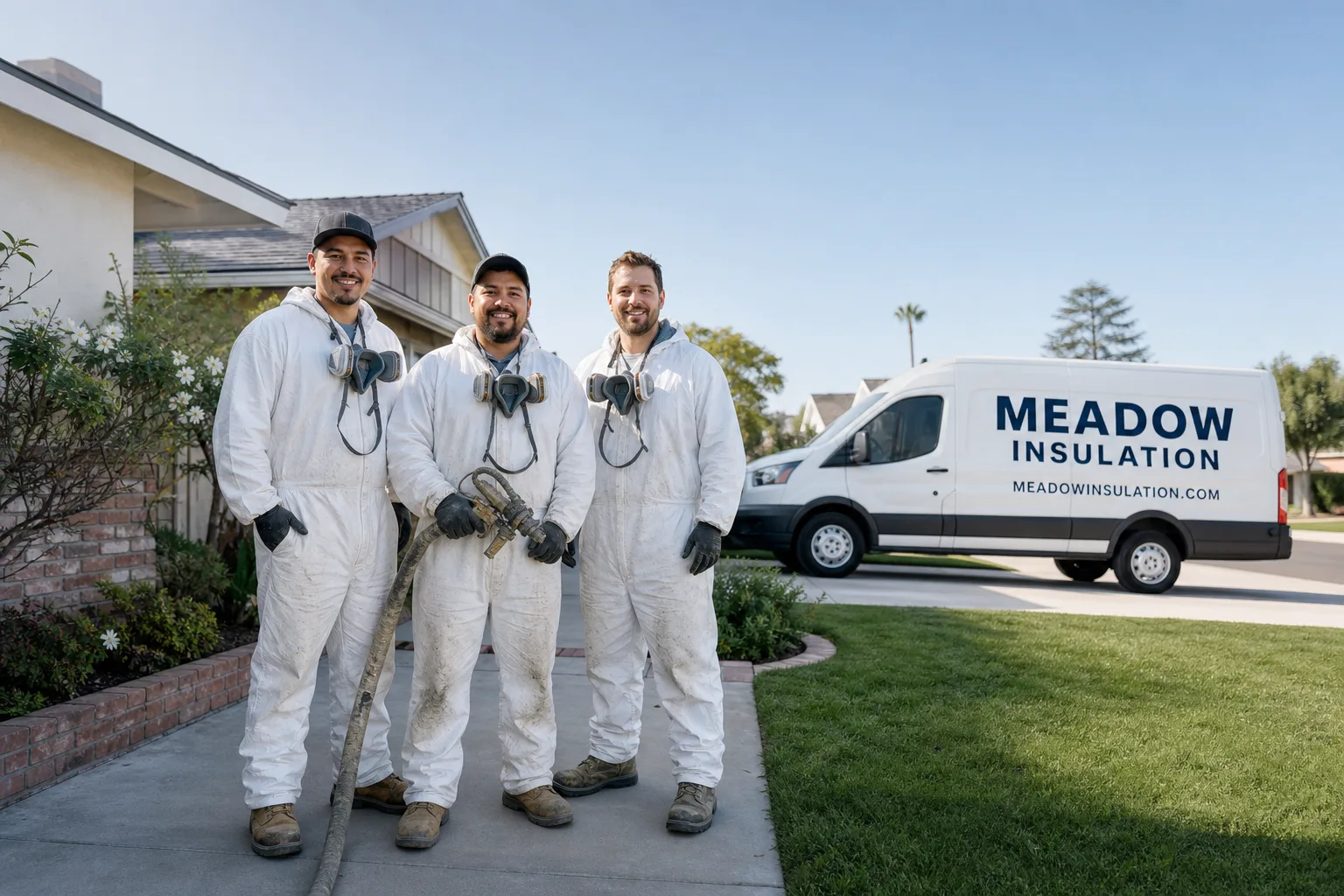
Fast, Reliable Spray Foam Insulation Across Avocado Heights
Spray foam insulation in Avocado Heights typically runs $2.50 to $6.50 per square foot installed, with most attic air-sealing and open-cell projects on 1950s-60s ranch homes landing between $2,800 and $7,400 depending on square footage and prep work. We’re Meadow Insulation, and we work these unincorporated LA County streets from Don Julian Road down to the San Gabriel River corridor every week. If your single-story ranch off Valley Boulevard is cooking in the afternoon and your AC can’t keep pace, call (833) 589-8312 for a free attic assessment.
Why Meadow Insulation Is Avocado Heights’s Preferred Spray Foam Insulation Company
Most Avocado Heights homes were built between the late 1940s and mid-1960s, and almost all of them share the same DNA: slab-on-grade foundations, stucco exteriors, shallow attics, and insulation that has long since stopped doing its job. We’ve crawled enough of these attics to know what we’re going to find before the ladder goes up. That’s not guesswork, it’s repetition.
Homeowners here tend to research before they call. They’ve already read about open-cell versus closed-cell, and they want to know whether anyone will take the time to check what’s actually inside their attic before spraying. Our team does. Led by Allen Drummond, our crews check wire condition, inspect the existing blown-in fill, and map the ceiling plane before any material leaves the truck. That pre-spray walk-through matters more in Avocado Heights than almost anywhere else we work, because these attics hide things newer tract homes don’t.
We’re authorized to install Spray Foam Insulation from Icynene and Demilec, two brands built specifically for this material, not generic lines stretched across five product types. Our response time to Avocado Heights is same-week for most jobs, and we schedule summer attic work for early morning hours when the heat is manageable and the foam cures correctly.
Open Cell Spray Foam in Avocado Heights
Open Cell Spray Foam is the workhorse for Avocado Heights ranch attics because it air-seals the ceiling plane while adding R-value, and it’s forgiving on the irregular framing these old homes have. When we spray open cell across a shallow 1950s attic lid, we’re doing two jobs at once: closing the air leaks that pull 140°F attic air into the living space, and creating a thermal barrier that stops radiant heat from cooking the ceiling drywall. Most Avocado Heights homeowners choose open cell for attic lids and exterior wall cavities where the budget favors coverage over maximum R-value per inch.
When the Attic Lid Is the Problem
In these slab ranches, heat doesn’t rise through the walls the way people assume. It radiates down from the attic. Open cell sprayed across the ceiling plane – after the existing settled fill is cleared or conditioned – changes how the whole house feels by early afternoon. This is the single highest-impact upgrade for a hot, dry San Gabriel Valley summer.
What Open Cell Costs Here
A typical open-cell attic lid in a 1,100 to 1,500 square foot Avocado Heights ranch runs $2,800 to $4,900 installed. That includes clearing the settled fill, prepping the deck, and spraying to code depth. Homes with converted garages or bump-out additions that were never insulated run higher because the wall-ceiling junctions need air-sealing before foam goes in.
Spray Foam Insulation Contractors in Avocado Heights
Spray Foam Insulation Contractors in Avocado Heights fall into two camps: generalists who will spray whatever you ask for, and specialists who look at the attic as a system before pulling the trigger. We’re the second kind. On a 1956 ranch off the Don Julian Road corridor, our crew opened the shallow attic to find the original blown-in compacted into a thin mat over early aluminum branch wiring, so we flagged the wiring for the homeowner’s electrician before any foam went down. Once cleared, we air-sealed the ceiling plane and sprayed open cell across the lid to cut the afternoon heat gain that was pushing attic temps past 140°F and driving the AC load. The result was a measurably cooler single-story home without disturbing the degraded original batts in the wall cavities.
Prep Work Most Contractors Skip
In Avocado Heights specifically, the prep matters as much as the spray. Foam laid over 50-year-old settled material traps moisture and hides whatever is underneath – sometimes knob-and-tube, sometimes early aluminum. We inspect, test, and document before we spray. If wiring needs attention, we pause and tell you. That’s not delay, that’s doing the job right.
Why You’ll Call Us Back
The homes here aren’t getting younger, and neither are their attics. Homeowners who’ve had us out once tend to call when a second project comes up: a converted garage that’s still uninsulated, an addition with no air barrier, a west-facing wall that radiates heat by 3 p.m. We answer the phone and we schedule fast.
Trusted Brands We Service in Avocado Heights
We carry spray foam from Icynene and Demilec, and we stock the full accessory line – gun cleaners, hose assemblies, prep materials – so we’re not waiting on supply runs when a Avocado Heights job runs long. For homeowners considering alternatives, we also install Rockwool mineral wool and CertainTeed fiberglass, so the recommendation you get is the one that fits your attic, not the one we have left in the warehouse. Eight brands, three methods, one installer who knows when to use each.
Common Spray Foam Insulation Problems We See in Avocado Heights Homes
- Foam over settled blown-in. Original 1950s-60s fill has compacted to a thin mat over the ceiling plane. Spraying fresh foam directly over it traps moisture and buries wiring that may need attention. We clear and condition the existing fill first.
- Mid-day summer flashing. Low, hot attics in these ranches can exceed safe application temps by 10 a.m. in July and August. Open cell applied too thick during peak heat cures poorly. We schedule sprays for early morning and monitor surface temp before each pass.
- Converted garages with no air barrier. Many Avocado Heights properties have detached garages converted to living space without a permit – and without insulation or an air seal at the wall-ceiling junction. Foam alone won’t fix the thermal bridge; that junction needs air-sealing first.
- Hidden wiring under the lid. Early aluminum branch wiring and the occasional knob-and-tube remnant sit beneath the settled fill in many of these attics. A trained eye spots it during prep. Spraying over energized, brittle wiring is a fire risk no crew should accept.
Pricing for Spray Foam Insulation in Avocado Heights, CA
Here are the numbers we quote most often for Avocado Heights ranch homes. Open-cell attic lids run $2,800 to $4,900 for a typical 1,100-1,500 square foot single-story. Closed-cell runs higher, $4.50 to $6.50 per square foot, and we recommend it where you need moisture barrier performance or maximum R-value per inch. Rim joist sealing on slab ranches runs $900 to $1,800. Garage ceiling spray foam runs $1,100 to $2,400 for a detached single-car garage. What affects cost: attic depth and access, whether the settled fill needs clearing, whether wiring needs an electrician’s sign-off, and whether we’re spraying walls or just the lid. Call (833) 589-8312 and we’ll walk your attic, measure it, and give you a written quote on the spot. Estimates are free.
We Also Serve Cities Near Avocado Heights
Our crews cover the surrounding San Gabriel Valley communities, including West Puente Valley, La Puente, Valinda, and El Monte. If you’re just outside the Avocado Heights boundary, we’ll still make the drive and give you the same attic-first assessment.
Serving Avocado Heights, CA — Our Local Coverage Area
We’re based in the Avocado Heights area and know this community well. Use the map below to see our service coverage — if you’re nearby, we can almost certainly help.
FAQs About Spray Foam Insulation in Avocado Heights
Because many of these 1950s-60s slab ranches still have early aluminum branch wiring or, occasionally, knob-and-tube remnants buried under 50-plus years of settled blown-in material. Spraying foam directly over aged, brittle wiring creates a heat trap and a potential fire risk. We check wire condition before any material goes down, and if we find something questionable we flag it for a licensed electrician. Call (833) 589-8312 and we’ll inspect before we quote.
No, not directly. The original blown-in fill in these homes has compacted into a dense mat that holds moisture and prevents proper foam adhesion. We clear or condition the settled material down to the ceiling plane, inspect what’s underneath, then spray. Skipping this step is how you end up with a failed install and hidden problems lurking under the new lid layer.
Because San Gabriel Valley summers push shallow attic temperatures past safe application limits by mid-morning. Open-cell foam flashed onto 130-140°F surfaces cures poorly and wastes material. We schedule Avocado Heights attic sprays for 6 to 10 a.m. during summer months, which also keeps our crew out of the worst heat. It’s safer for the install and better for the foam.
Usually yes, but the foam has to be paired with air-sealing at the wall-ceiling junction. Many of these tract homes have garages or additions converted decades ago with no insulation and no air barrier, so heat moves through the framing even after foam goes in. We seal the junction first, then foam the lid and walls as needed. A single converted garage typically runs $1,100 to $2,400 depending on size and access.
For most of these ranches, yes. A shallow attic with no effective insulation turns into a 140°F+ oven on summer afternoons, and open-cell foam across the ceiling plane attacks that heat gain directly. But if the walls are uninsulated too – common in these slab-on-grade builds – we’ll tell you what foam can and can’t do, and whether a wall insulation upgrade is worth adding. Call (833) 589-8312 for a straight read on your specific home.
Written by Allen Drummond, Owner at Meadow Insulation, serving Avocado Heights and the San Gabriel Valley.