
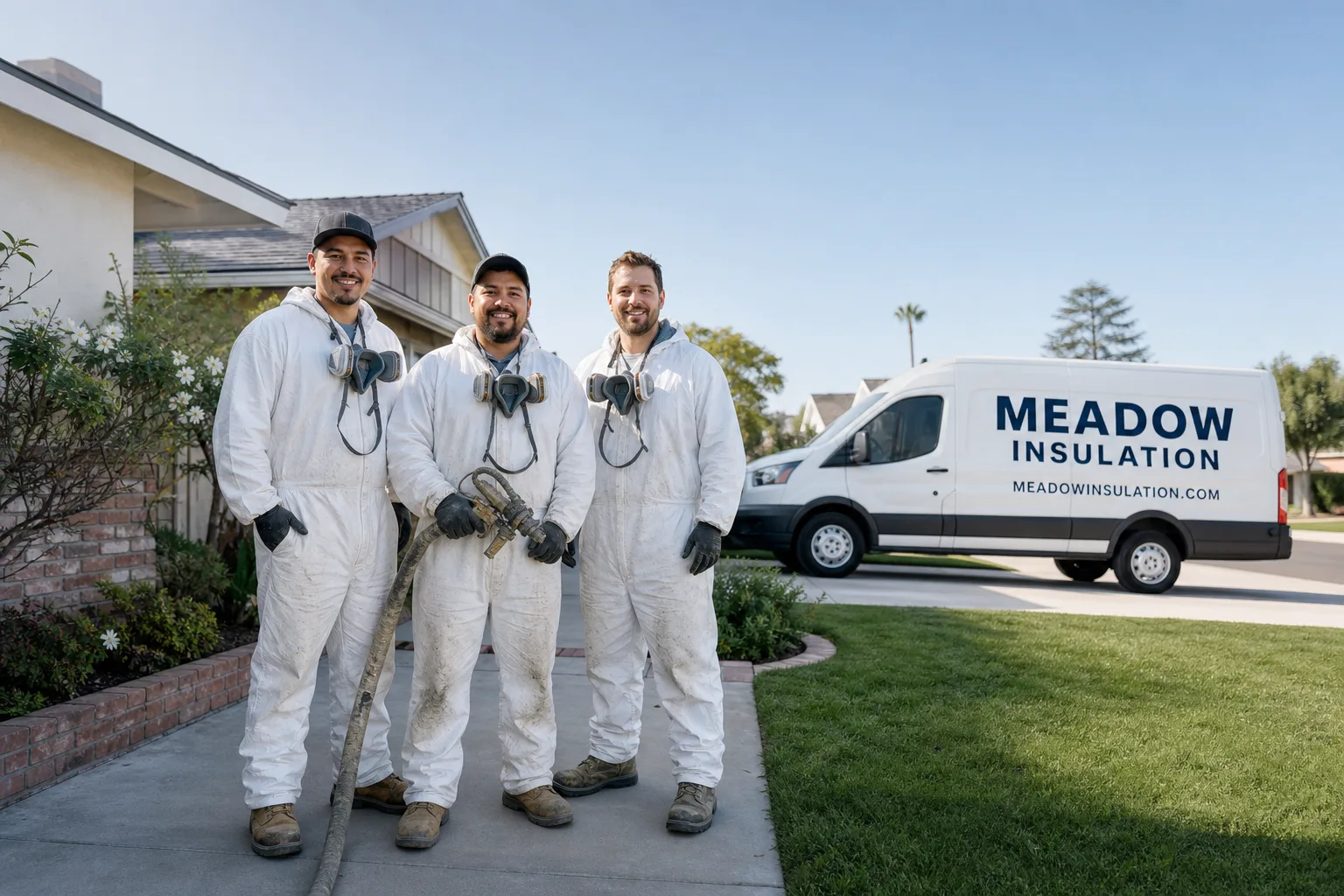
Fast, Reliable Spray Foam Insulation Across Eastvale
Spray foam insulation in Eastvale typically runs $2.50 – $6.50 per board foot installed, depending on whether you need open-cell or closed-cell foam, and most jobs in our 92860 service area are done in a single day. If your two-story tract home off Hamner Avenue or Archibald Street still has builder-grade fiberglass from the mid-2000s, you’re losing cooled air through your attic every afternoon the temperature climbs past 95°F. We know these homes because we work on them every week. Call us at (833) 589-8312 for a free estimate, and we’ll tell you honestly whether spray foam is the right fix or you’d be better served by a different material from our lineup.
Meadow Insulation is a material-agnostic insulation specialist serving Eastvale with full coverage of spray foam, blown-in, and attic insulation. The right insulation for your home’s structure, not just the easiest one to install.
Why Meadow Insulation Is Eastvale’s Preferred Spray Foam Insulation Company
Eastvale homeowners call us because their attics are baking. A 2012 house on the east side of town near Riverbend Park can hit 140°F in the attic by mid-July, and that heat bleeds straight into upstairs bedrooms all evening. We’ve worked in neighborhoods across Eastvale, from the Riverbend tract off Schleisman Road to newer developments near Cedar Creek Park, and we understand the specific construction patterns those homes share.
Our response time to Eastvale is usually next-day for estimates and within the same week for most spray foam jobs. We stock Icynene and Demilec foam products locally, so we’re not waiting on a distributor in Corona or Ontario to start your project. Allen Drummond runs our crews, and he trains every installer on the tight-lot access issues that come up constantly in Eastvale: steep tile roofs, long hose runs from street-parked rigs, and attics where the original batts have compressed into nothing useful.
We’re not the cheapest spray foam company in the Inland Empire, and we won’t pretend to be. We’re the one that tells you when spray foam is the wrong choice for your attic. That’s why homeowners who start with a free estimate tend to stick with us for the actual work.
Rim Joist Spray Foam in Eastvale
Rim joist spray foam in Eastvale is one of the highest-ROI upgrades for 2000s – 2010s tract homes, because the rim joist area where your second-floor framing meets the foundation was rarely air-sealed properly during the original build. In Eastvale, most homes on former dairy land were built fast during the housing boom and the rim joists were left with fiberglass batts shoved in loosely, if they were insulated at all. Closed-cell spray foam closes that gap permanently. A full rim joist job in Eastvale typically runs $1,200 – $2,800, depending on the perimeter length and whether we’re removing old batts first.
Where the heat actually gets in
The rim joist is the band of wood that runs around the perimeter of your house, sitting on top of the foundation wall. In a Eastvale two-story, hot exterior air pushes into this band all summer, and the original fiberglass does almost nothing to stop it. Spray foam expands into every seam and creates an air seal that fiberglass simply cannot.
What we do on site
We haul out the old batts, check for any moisture or termite signs (common in Eastvale’s irrigated former-farmland soil), and spray two inches of closed-cell foam across each joist bay. The whole job usually takes four to six hours for a typical Eastvale floor plan.
Crawl Space Spray Foam Insulation in Eastvale
Crawl space spray foam insulation in Eastvale matters because many of the city’s tract homes sit on raised foundations over shallow crawl spaces, and those spaces were left unsealed by the original builders. During Eastvale’s long hot summers, that means warm air seeps up through your floors while cool air drops out through the vents. We spray closed-cell foam on the crawl space ceiling and rim joists to seal the envelope. A typical Eastvale crawl space job runs $1,800 – $4,500, with total size and access difficulty driving the final number.
Closed-cell against the subfloor
Closed-cell foam in the crawl space kills two problems at once: it stops the air movement that makes floors feel warm in summer, and it acts as a vapor barrier. Eastvale’s soil was dairy farmland for decades, so the ground holds moisture. Open-cell foam absorbs water, which is why we almost always recommend closed-cell in these crawl spaces.
What homeowners notice first
After a crawl space seal, our Eastvale customers usually tell us their first-floor rooms feel noticeably cooler by late afternoon and the house holds its temperature longer after the AC cycles off. A few have also mentioned fewer ants and spiders coming up through the floor, which is a nice side effect of closing those entry points.
Trusted Brands We Service in Eastvale
We install spray foam from Icynene and Demilec, two of the most respected names in open-cell and closed-cell applications. For Eastvale homes where foam isn’t the right call, we also work with Rockwool for mineral wool batts and Knauf for fiberglass, which gives you an honest recommendation path rather than a default to whatever we have in the truck. We keep Icynene open-cell and Demilec closed-cell products in local stock, so Eastvale jobs don’t stall waiting on a parts run to Orange County. From blown-in cellulose to closed-cell spray foam, we match the material to the problem.
Common Spray Foam Insulation Problems We See in Eastvale Homes
- Compressed builder-grade fiberglass batts: The original R-13 batts in Eastvale’s steep tile attics sag and compress after a few summers of 100°F+ heat. Once compressed, they leave uninsulated gaps at the eaves and knee walls where spray foam must be applied to restore the thermal barrier.
- Dust-coated radiant barriers: Radiant-barrier sheathing installed during original construction loses its reflectivity as a layer of dust settles on the foil. Homeowners in Eastvale often think the barrier is still working, but their attic temps still spike above 140°F, meaning the barrier is effectively dead as an energy saver.
- Inconsistent foam from street-parked rigs: Tight lots and steep roofs force many spray-foam rigs to park on the street or in narrow driveways. Long hose runs can cause inconsistent application pressure if the crew isn’t experienced with Eastvale’s access constraints. We’ve corrected this exact problem on several jobs where the original installer left thin spots near the eaves.
- Warm upper floors in late afternoon: A complaint we hear constantly in Eastvale’s two-story tract homes. The attic superheats during the day, the builder-grade insulation transfers that heat downward, and the upstairs bedrooms won’t cool until after 9 or 10 pm. Closed-cell foam against the roof deck changes that dynamic entirely.
On a recent job in the Riverbend tract off Schleisman Road, our crew found the attic of a 2008 two-story still stuffed with compressed R-13 batts and foil radiant-barrier sheathing that had lost its reflectivity under a layer of dust. We removed the failing batts, air-sealed the top plates, and sprayed 2 inches of closed-cell foam against the roof deck before adding blown-in fiberglass to hit R-38. The homeowner reported a 5 – 7°F drop in upstairs afternoon temperatures and a noticeably quieter second floor.
Pricing for Spray Foam Insulation in Eastvale, CA
Open-cell spray foam in an Eastvale attic runs $2.50 – $3.75 per board foot, while closed-cell runs $4.50 – $6.50 per board foot. A full attic air-seal plus open-cell foam on the roof deck for a typical 2,200 – 2,800 square foot Eastvale home lands between $4,000 and $7,500. Rim joist sealing, as mentioned above, is $1,200 – $2,800. Crawl space work starts around $1,800. The specific foam product, square footage, and whether we’re removing old insulation all move the number. Estimates are free, and we give you a line-item breakdown before any work starts. Call (833) 589-8312 for an exact quote on your Eastvale home.
We Also Serve Cities Near Eastvale
Beyond Eastvale, our crews regularly work in Norco, Home Gardens, Corona, and Jurupa Valley. If you’re in a neighboring community in Riverside County, see our Spray Foam Insulation page for the full scope of what we do, or call (833) 589-8312 and ask for Allen Drummond. We can usually reach most of these cities within a day for an estimate.
Serving Eastvale, CA — Our Local Coverage Area
We’re based in the Eastvale area and know this community well. Use the map below to see our service coverage — if you’re nearby, we can almost certainly help.
FAQs About Spray Foam Insulation in Eastvale
Yes, closed-cell spray foam applied to the underside of your roof deck dramatically reduces attic temperatures because it stops the radiant heat from the tile roof from entering the attic space in the first place. Eastvale attics with original fiberglass batts regularly hit 140°F in summer. After closed-cell foam, most of our customers see attic temps drop by 30 – 50°F. Call (833) 589-8312 for a free attic assessment.
No. Eastvale’s 2000s – 2010s tract homes were built with minimum-code fiberglass, which at the time was R-30 or less in the attic. Current standards recommend R-38 to R-49 for the Inland Empire’s heat, so a home built in 2005 is actually under-insulated by today’s standards. The original batts in many of these homes have also compressed or been disturbed by contractors running wiring and plumbing. Your house being 10 – 20 years old doesn’t mean it’s insulated well; it means it’s insulated to 2005 code, which is not the same thing.
Usually yes, especially if the original batts are compressed, dusty, or showing signs of rodent activity. We remove the old fiberglass, inspect the top plates and any existing radiant barrier, air-seal the gaps, then apply foam. Leaving old batts in place under spray foam can trap moisture and reduce the foam’s adhesion. On some Eastvale homes where the original batts are still in decent shape, we may spray foam the band joists and leave the batts alone. We’ll tell you which route makes sense after we look at your attic.
Yes. Closed-cell spray foam is the best option for Eastvale crawl spaces because it air-seals and acts as a moisture barrier at the same time. Many Eastvale tract homes sit on raised foundations over shallow, vented crawl spaces that were never part of the original thermal envelope. Spraying the crawl space ceiling and rim joists with closed-cell foam stops the heat and humidity transfer. The moisture resistance matters here specifically because Eastvale was built on former dairy farmland and the soil holds more water than you’d expect in a dry climate.
The sequence we recommend for Eastvale homes is: remove the original batts, air-seal the attic floor and top plates with closed-cell foam, assess the radiant barrier’s condition (it’s usually dust-coated and ineffective), then either spray foam the roof deck entirely or install fresh blown-in insulation to R-38 or better. The roof-deck foam route costs more upfront but converts the attic into a semi-conditioned space, which makes a huge difference in upstairs comfort during Eastvale summers. Call (833) 589-8312 and we’ll walk you through both options with real numbers.
Written by Allen Drummond, Owner at Meadow Insulation, serving Eastvale and the surrounding Inland Empire communities.