
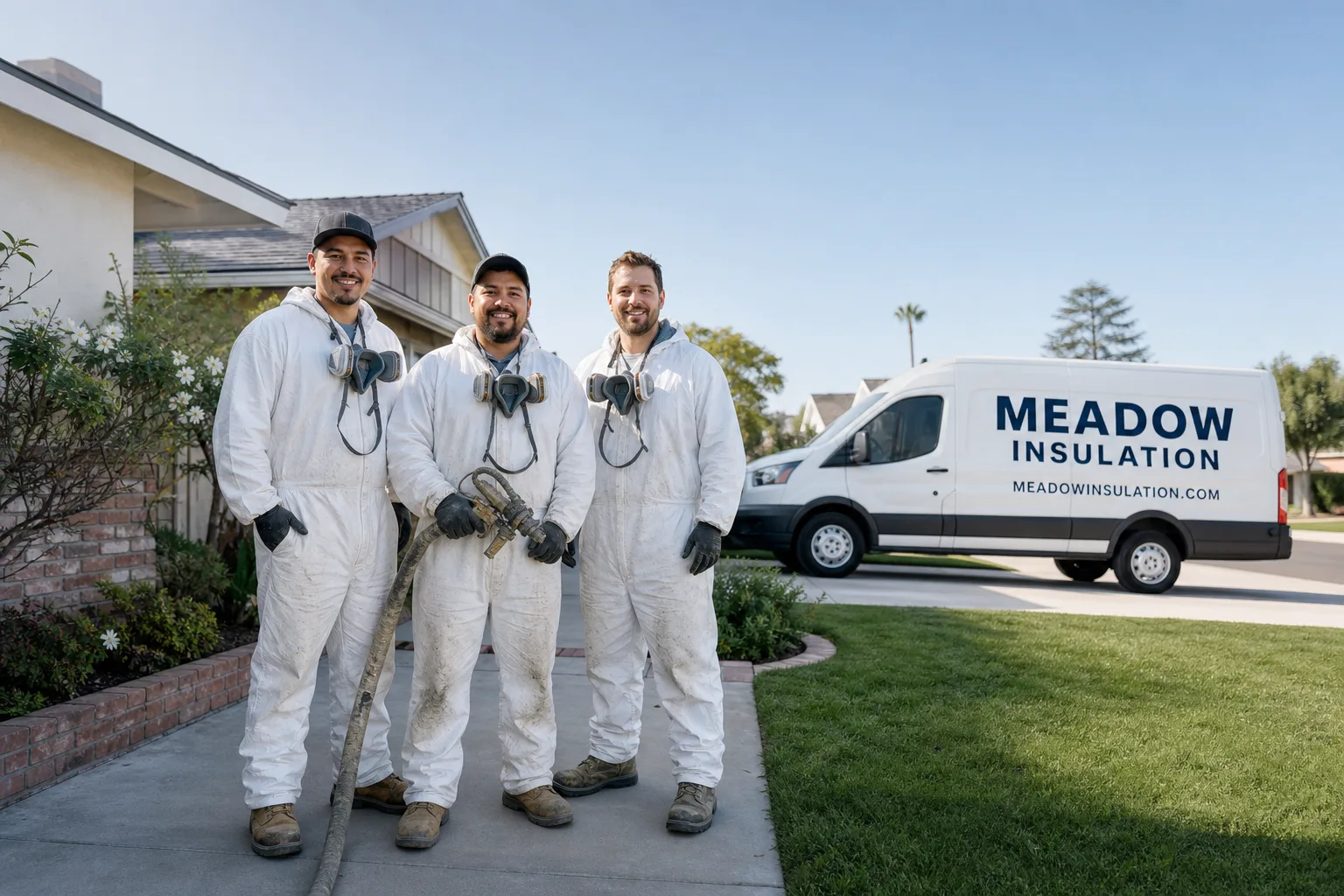
Spray Foam Insulation in South San Jose Hills: What It Costs and Why Wind Exposure Changes the Job
Spray foam insulation in South San Jose Hills typically runs $2,200 to $6,800 for a full attic application, with rim joist work falling between $900 and $1,700 and garage ceilings from $1,200 to $2,400. Open-cell foam lands on the lower end for interior walls and attic floors, while closed-cell foam costs more but adds structural rigidity and a vapor barrier. Most jobs in the hillside tracts off ZIP 91792 are completed in one day. Call (833) 589-8312 for a free estimate on your home.
South San Jose Hills isn’t like West Covina or Rowland Heights when it comes to insulation. The community sits on exposed slopes where Santa Ana winds scour wall cavities and pull conditioned air straight out of your attic. Radiant heat from sun-baked roof decks works against you in summer. You need a foam application planned around those two forces, not a generic install. That’s what we do at Spray Foam Insulation from Meadow Insulation.
Why Meadow Insulation Is South San Jose Hills’s Preferred Spray Foam Insulation Company
Our crews have worked through enough South San Jose Hills homes to know what’s behind the drywall before we open it. The single-story ranch and tract homes built from the 1950s through the 1970s share a pattern: low-pitch attics, wood-frame construction, and original insulation that was thin to begin with and has settled badly since. We plan for that before the first cut.
South San Jose Hills homeowners call us for the same reason they’d ask a neighbor who actually works on local houses: we know where the failure points are. South- and west-facing roof slopes get hammered by afternoon sun. Wind finds every unsealed penetration. We address both in every bid, and our estimates are free.
Response time to the 91792 ZIP code is usually within one to two business days for estimates, and emergency air-sealing work can often be scheduled inside a week. Licensed and insured, with an installation team led by Allen Drummond, who has spent years diagnosing insulation failures specific to inland foothill housing stock.
Spray Foam Insulation Contractors in South San Jose Hills
Spray Foam Insulation Contractors in South San Jose Hills deal with a specific set of conditions: slopes, wind, and sun. The job starts with a blower door test or thermal imaging walkthrough to find where air is actually moving. Then we air-seal the attic floor before adding any R-value. Foam goes in after the leaks are closed, not before. In these hillside homes, skipping the air-sealing step means the wind keeps pulling heat out no matter how much insulation you stack on top.
Expect a typical attic spray foam project in South San Jose Hills to run from $2,200 to $6,800 depending on square footage and whether you choose open-cell or closed-cell. Rim joist sealing, a common upgrade for the drafty crawlspace walls under these older ranch homes, runs $900 to $1,700.
Open-Cell for Interior Walls
Open-cell foam expands to fill odd-shaped cavities in 1950s-1970s framing. It’s the right choice for interior wall retrofits where you want sound dampening and air sealing without the higher material cost of closed-cell.
Closed-Cell for Roof Decks and Wind Exposure
On south- and west-facing roof slopes in South San Jose Hills, closed-cell foam is often the better call. It adds structural strength, resists wind-driven moisture, and performs as a vapor barrier. For homes that get direct Santa Ana exposure, that matters.
Spray Foam Attic Insulation in South San Jose Hills
Spray Foam Attic Insulation in South San Jose Hills is the single highest-impact upgrade you can make on a mid-century ranch with a low-pitch roof. Those attics are tight, hot, and leaky. The foam seals the attic floor penetrations and can be applied to the underside of the roof deck to turn the attic into conditioned space. In the hillside tracts off ZIP 91792, where radiant barriers have degraded and batts have settled into dust, spray foam is the fix that actually holds.
Cost for attic spray foam in South San Jose Hills ranges from $2,200 to $6,800 for a complete application. Add a radiant barrier replacement on a south- or west-facing slope and you’re looking at an additional $600 to $1,400 depending on roof area.
Sealing Before Insulating
We always seal first. Convective loops through recessed lights, plumbing penetrations, and attic hatches undo even the best insulation. Spray foam is the only material that seals while it insulates, which is why it outperforms batts in these older homes.
Low-Pitch Attic Access
Low-pitch attic spaces in South San Jose Hills ranch homes are tight. Our crews use specialized application wands and crawl techniques developed specifically for these cramped conditions. The work takes a day or two.
Trusted Brands We Service in South San Jose Hills
Meadow Insulation installs spray foam from Icynene and Demilec, two manufacturers that produce both open-cell and closed-cell formulations. For homes where spray foam isn’t the right fit, we stock Owens Corning fiberglass, Johns Manville batts, and Rockwool mineral wool. We keep material on hand for South San Jose Hills jobs, so turnaround on 91792 zip code projects is usually faster than waiting on a special order from a distributor. Having access to multiple manufacturers means the recommendation you get is based on your home’s exposure, not what’s already in our warehouse.
Common Spray Foam Insulation Problems We See in South San Jose Hills Homes
- Settled, dust-filled batt insulation in low-pitch attics. The original fiberglass from a 1965 build is often less than R-19 now, and compressed in places to less than R-11. Spray foam seals the bypasses that let heat loop around whatever R-value remains.
- Sun-degraded radiant barriers on south- and west-facing roofs. Reflective barriers lose their reflectivity after 15-20 years of direct foothill sun. Replacing them or switching to closed-cell foam on the roof deck stops the afternoon heat gain that turns attics into ovens.
- Santa Ana wind scour through wall cavities and attic penetrations. Wind-driven air infiltration is worse on these slopes than in Valinda or Walnut below. Foam’s air-sealing properties address this directly.
- Garage ceiling and rim joist gaps. In 1950s-1970s ranch construction, the garage ceiling often has no insulation at all, and the rim joist is open to the crawlspace. Both are prime spots for spray foam upgrades in South San Jose Hills homes.
Pricing for Spray Foam Insulation in South San Jose Hills, CA
Here’s what we quote on typical South San Jose Hills projects: open-cell attic floor application, $2,200 to $4,200 for an average 1,200-square-foot attic. Closed-cell roof deck application on the same home, $3,800 to $6,800. Rim joist sealing in a crawlspace, $900 to $1,700. Garage ceiling spray foam, $1,200 to $2,400. Radiant barrier replacement on a sun-exposed slope, $600 to $1,400. The biggest factors are square footage, access difficulty, and whether you’re sealing the attic floor or the roof deck. Call (833) 589-8312 for an exact number; the estimate is free and takes about an hour on site.
We Also Serve Cities Near South San Jose Hills
Our crews work across the eastern San Gabriel Valley. In addition to South San Jose Hills, we regularly install spray foam in Valinda, Walnut, West Covina, and Rowland Heights. If you’re in a neighboring community with the same hillside wind exposure or older housing stock, the same planning approach applies.
Serving South San Jose Hills, CA — Our Local Coverage Area
We’re based in the South San Jose Hills area and know this community well. Use the map below to see our service coverage — if you’re nearby, we can almost certainly help.
FAQs About Spray Foam Insulation in South San Jose Hills
Spray foam is an air barrier as well as an insulator, so it stops wind-driven air movement through wall cavities and attic bypasses that batts simply cannot seal. In South San Jose Hills, where Santa Ana winds push air through every gap in a 1960s frame, that sealing property is the difference between an insulation job that works and one that just fills space. Call (833) 589-8312 for a quote on your home’s specific exposure.
We remove the failed radiant barrier and either replace it or apply closed-cell spray foam to the underside of the roof deck. Closed-cell foam reflects less heat than a fresh barrier but seals the deck and adds R-value, which a degraded barrier never did. The choice depends on your roof condition and budget.
For attic floors, R-38 is the minimum we recommend, and we often pair 2 inches of closed-cell foam at the roof deck with blown-in fiberglass on the attic floor to reach R-38 or R-49. The exact number depends on your home’s orientation and how much sun your west slope takes. We’ll walk you through the math during the estimate.
Yes, and this is one of the first things homeowners notice after we finish. Closed-cell foam applied to rim joists, attic penetrations, and wall cavities stops the air movement that carries dust from the crawlspace and attic into living areas. In a 1960s ranch with settled batts, the difference is immediate. Call (833) 589-8312 to schedule a look.
Spray foam is the best material for low-pitch attics because it doesn’t require the vertical clearance that blown-in or batt insulation does to reach its rated R-value. The foam expands into the tight corners and seals the roof deck directly, turning a cramped hot attic into conditioned or semi-conditioned space. Our crews have worked in hundreds of these attics across ZIP 91792.
Written by Allen Drummond, Owner at Meadow Insulation, serving South San Jose Hills and surrounding communities.