
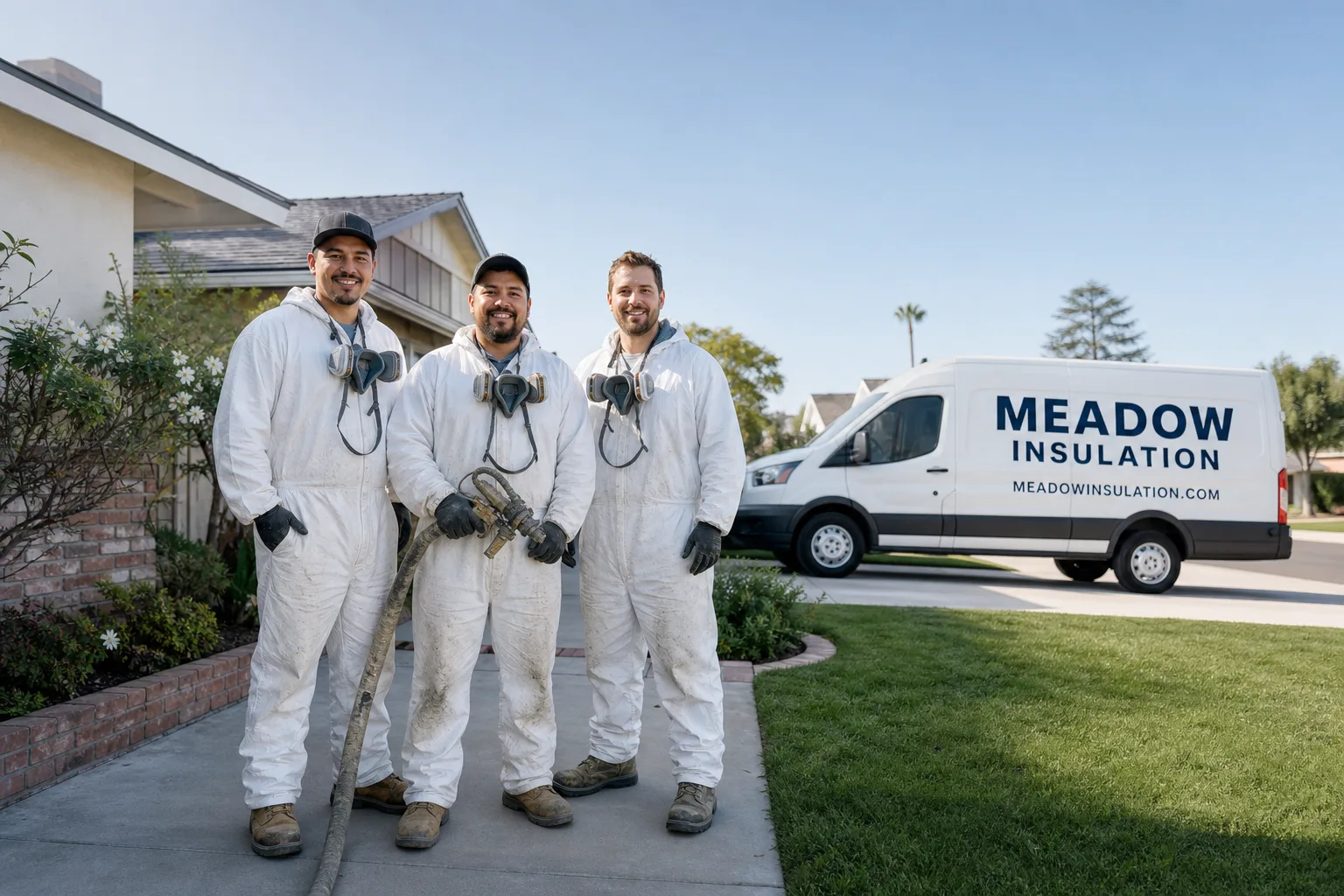
Fast, Reliable Spray Foam Insulation Across Corona
If your Corona home’s attic turns into an oven every summer and your AC runs nonstop, spray foam insulation is typically the fix, not more insulation on the floor. We install open-cell and closed-cell spray foam throughout Corona, usually within 3 to 5 business days of your call. Meadow Insulation is led by Allen Drummond, and our crews know the Inland Empire’s heat patterns street by street. Call (833) 589-8312 for a free estimate.
Most Corona homeowners call us because they notice uneven room temperatures, second-story bedrooms that never cool down, or energy bills that spike every July. Spray foam addresses the problem at the source: it seals the attic and rim joists so hot air stops moving through your house. We serve every Corona ZIP code, from the older streets near downtown to the newer tracts in the hills.
Why Meadow Insulation Is Corona’s Preferred Spray Foam Insulation Company
Corona’s housing stock is a mix of mid-century single-story ranches and 1980s to 2000s two-story tract homes, and each requires a different spray foam approach. We don’t sell the same job twice. Our Spray Foam Insulation team has worked in attics off Ontario Avenue, in the developments above Eagle Glen, and in the flatlands west of the 15. That matters because a low-pitch attic near downtown is not the same job as a tall attic in a two-story home in Eastvale-adjacent 92883.
Homeowners in Corona tell us two things consistently: they want someone who shows up when promised, and they want a straight answer about whether spray foam is worth the cost. That’s how we run every job. Allen Drummond started Meadow Insulation to be the company that gives homeowners an honest product recommendation, not a pitch. We bring that same approach to every Corona attic we inspect.
Our response time to Corona is typically same-week, and we stock the materials needed for both open-cell and closed-cell applications locally. That means we don’t reschedule because a truck had to run back to a warehouse across the county. Most Corona jobs are completed in a single day once foam is being sprayed.
Spray Foam Insulation Contractors in Corona
Spray Foam Insulation Contractors in Corona have a job that is different from contractors in coastal Orange County. Here, the work is about fighting heat gain and moisture from the marine layer, not just adding R-value. A typical open-cell spray foam installation in a Corona attic runs $1,500 to $3,800 depending on square footage and access difficulty. Closed-cell runs $2,800 to $6,500 and is the better choice when you need an air barrier plus structural rigidity on an older roof deck.
When we inspect a Corona attic, we look for the failures that are common here: displaced batts around recessed lights, gaps around HVAC chases, and thin dust-covered roof decks that cause poor foam adhesion. The job involves cleaning the deck, air-sealing penetrations, and then applying the foam to the appropriate depth for the structure. A 1960s ranch with a low-pitch attic needs a different foam depth and type than a 2005 two-story with a tall hip roof.
Open-Cell and Closed-Cell Applications
In Corona’s dry climate, open-cell foam works well for interior walls and ceiling cavities where you want sound dampening and air sealing. Closed-cell is the stronger performer on roof decks that need to reject summer’s radiant heat. We install both, and we don’t push one over the other unless the structure calls for it.
Rim Joist and Garage Ceiling Work
Rim joist spray foam stops hot air from entering a home at the band joist, where the floor meets the foundation wall. Garage ceiling spray foam isolates the garage attic so it doesn’t heat the rooms above. Both jobs are common in Corona’s tract homes, where garage ceilings and rim joists were often left uninsulated or sealed with only fiberglass by the original builder.
Spray Foam Attic Insulation in Corona
Spray Foam Attic Insulation in Corona is the highest-impact insulation job a homeowner here can do. Corona attics routinely exceed 150°F in summer, and when an attic is only insulated with sagging R-11 or R-13 batts, that heat radiates directly into the living space below. A full attic spray foam job in Corona, including air sealing and foam application to the roof deck or attic floor, typically runs $2,500 to $6,000 depending on attic size and roof complexity.
The heat is the obvious enemy, but Corona’s marine layer creates a second problem most homeowners never hear about. Mornings bring moist air off the coast, and when that moisture gets trapped in a foam-sealed attic without proper venting, it condenses on the underside of the roof sheathing. That leads to deck rot. In older neighborhoods like those off Grand Boulevard, we check venting before we touch a roof deck with foam.
Roof Deck Foam for Radiant Heat Rejection
Foam applied to the underside of the roof deck turns the attic into a semi-conditioned space, which keeps ductwork from baking and lowers the temperature of the air entering your HVAC system. In Corona’s older low-pitch ranches, this is often the only way to make an upstairs livable without adding a second AC unit.
Air Sealing Before Foam Application
Spray foam that is applied over gaps and chases without air sealing first will underperform. We seal around recessed lights, bathroom fan housings, and plumbing penetrations before the foam goes in. It’s painstaking work, and it’s the step that separates a foam job that works from one that only looks good in photos.
Trusted Brands We Service in Corona
Meadow Insulation is authorized to install Icynene and Demilec spray foam, two brands with proven performance records in hot, dry climates like the Inland Empire. Icynene’s open-cell foam is a reliable choice for attic air sealing, while Demilec’s closed-cell products hold up well on Corona roof decks that see extreme temperature swings. We also work with Johns Manville, Knauf, and CertainTeed when a job calls for a hybrid approach combining spray foam with batt or blown-in products. For Corona customers, that means we match the product to the problem and can usually source any necessary materials without delay.
Common Spray Foam Insulation Problems We See in Corona Homes
- Delamination from dusty roof decks: Corona’s dry climate fills attics with fine dust, and foam sprayed over that dust won’t adhere. We clean the deck before application, every time. Skipping this step means the foam peels away within a few years.
- Condensation from marine layer moisture: Older homes near the Circle and off Grand Boulevard often have attics with marginal venting. When foam seals the attic and traps morning marine layer moisture, condensation forms on the sheathing. Proper venting or a conditioned attic design prevents this.
- Gaps around recessed lights and HVAC chases: Decades of service calls leave batts displaced and chases unwrapped. Even a well-installed foam job will underperform if those gaps aren’t sealed first, because hot attic air finds the path of least resistance.
- Thin foam over legacy batts: Some contractors spray a thin layer of foam over existing fiberglass and call it done. Without a continuous air barrier, heat bypasses the foam and pours through gaps. We address the air barrier first and the R-value second.
Pricing for Spray Foam Insulation in Corona, CA
Spray foam insulation pricing in Corona runs higher than in coastal cities because of travel distance and the prep work older attics require. Open-cell attic foam runs $1,500 to $3,800. Closed-cell roof deck foam runs $2,800 to $6,500. Rim joist spray foam runs $400 to $1,200 for a typical two-story tract home, and garage ceiling foam runs $600 to $1,800. Attic access, roof pitch, and the amount of existing insulation that must be removed all move the number. We give you a written quote before work starts, and estimates are free.
We Also Serve Cities Near Corona
Meadow Insulation serves homeowners across western Riverside County, including Home Gardens, El Cerrito Corona, Eastvale, and Norco. If you’re in one of those communities and need spray foam, the same crew that works Corona jobs can reach you. Call (833) 589-8312 and we’ll schedule a time that works.
Serving Corona, CA — Our Local Coverage Area
We’re based in the Corona area and know this community well. Use the map below to see our service coverage — if you’re nearby, we can almost certainly help.
FAQs About Spray Foam Insulation in Corona
No, and this is where many Corona homeowners get burned by cut-rate installers. Spray foam needs a clean, sound surface to adhere properly. Laying foam over old fiberglass batts traps heat and moisture between the layers, and the foam won’t form a continuous air barrier. The old batts need to be removed or, at minimum, pushed aside and the deck cleaned before foam goes in. It’s more labor, but it’s the only way the job works. Call (833) 589-8312 and we’ll tell you exactly what your attic needs before quoting.
Corona’s marine layer brings morning humidity that can condense on the underside of a roof deck, and a foam-sealed attic without proper venting makes that condensation worse. We check venting and roof deck condition before recommending spray foam, especially in older ranches where original venting may be marginal. In some attics, adding a ridge vent or switching to a conditioned attic design solves the moisture problem. Skipping this check leads to deck rot that stays hidden until it’s expensive.
Closed-cell foam is typically the better choice for low-pitch attics in downtown Corona ranches. Those attics have limited room to work and low roof decks that trap heat, and closed-cell delivers more R-value per inch than open-cell. It also adds structural strength to older roof decks, which matters on 50-year-old ranches. Open-cell can work if the attic is vented properly and the goal is primarily air sealing, but closed-cell gives you heat rejection and moisture resistance in one application.
Upstairs rooms that run 10 to 15 degrees hotter than the rest of the house are the most common sign, as are AC bills that climb every summer and attic spaces that feel like a sauna when you open the hatch. Displaced or compressed batts, dust-filled insulation, and gaps around recessed lights and ducts all point to heat-related failure. We recently foamed a 1960s ranch near the Circle where the original R-11 batts had been displaced around recessed lights and a central HVAC chase, letting 150°F attic air pour into the living space. After air sealing and applying 2 inches of Icynene closed-cell foam, the homeowner reported a 12°F drop in upstairs bedroom temperature during a triple-digit week. If any of those symptoms sound familiar, call (833) 589-8312 and we’ll inspect the attic.
Yes, and it’s the single most effective thing you can do for a Corona attic in summer. Closed-cell foam on the roof deck blocks radiant heat before it enters the attic, and air sealing stops hot air from circulating through the living space. Homeowners tell us their attics stay 30 to 40 degrees cooler after foam installation, and their AC systems cycle far less. The temperature drop depends on the roof’s orientation and the home’s construction, but the result is consistent: a cooler attic and a lower bill.
If your Corona home is baking this summer and you want a straight answer about whether spray foam is right for your attic, call (833) 589-8312. We’ll inspect the attic, explain what we see, and give you a written quote. Estimates are free, and we won’t recommend foam unless the structure warrants it. Meadow Insulation is led by Allen Drummond, and we’re ready to put our knowledge of Corona’s homes to work for you.
Written by Allen Drummond, Owner at Meadow Insulation, serving Corona and western Riverside County.